 NU is all about fresh perspectives. So is our website.




The NU Story
Breaking stereotypes
The idea takes shape
The idea of setting up a not-for-profit university came from a desire to create a new model of higher education that is relevant to the industry requirements of the 21st century. Technology, industry and economy were advancing fast and higher education needed to reinvent itself to cope with these demands.
Mr Pawar, an ‘ideas man’, saw a need to transform the higher education system to bring it to the global standards of higher education and to open up new possibilities for students. Just as he was deliberating on the idea, regular interactions with acclaimed educationists triggered the idea of the four core principles on which NU is built.
Validation
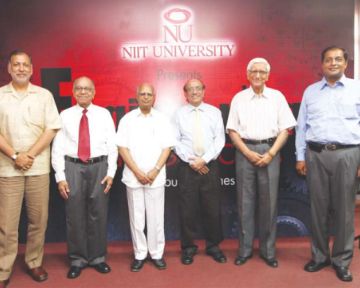
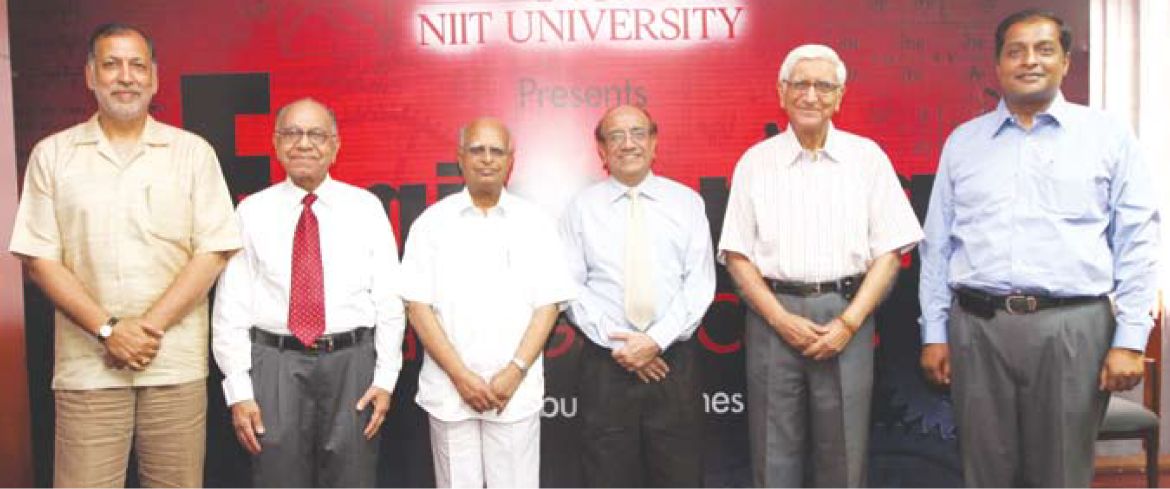
The first step - Board of Advisors
Late Prof PV Indiresan
Late Prof JR Isaac
Retd Professor, IIT Bombay; Former Advisor, NIIT Ltd
Late Prof C S Jha
Late Prof MP Kapoor
Retd Professor, IIT Kanpur; Former Director, TIET; Project Director, NIIT Institute of Information Technology (TNI)
Dr Kiran Karnik
Prof RC Malhotra
Dr RA Mashelkar
Prof Ashok Misra
Late Dr CR Mitra
Former Director, BITS, Pilani; Former Advisor, NIIT
Prof VS Prasad
Prof VS Raju
Prof PB Sharma,
Rajendra Singh Pawar
President, TNI; Chairman, NIIT
Vijay K Thadani
Chairman, BOG, TNI; CEO, NIIT
P Rajendran
COO, NIIT
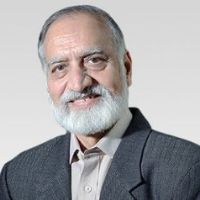
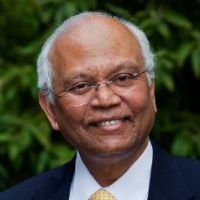
At that time we were talking of creating something truly world-class, but in a broader sphere of work. The IITs spell quality in engineering education, but we wanted to emulate the range of quality in a broader range of disciplines.”
Dr Kiran Karnik, Member, Advisory Board (NU) and former president, NASSCOM.
Despite having a marquee advisory board, it was tough going for a corporate group like NIIT Ltd. — even with its illustrious history of education delivery — to venture into the formal higher education domain.
Challenges notwithstanding, the determined founders decided to walk the arduous path and build the university of their dreams.
A strong foundation
Mr Pawar and his team were very clear that if they had to create a university, it would focus on the scope and not the scale. It had to be a university with a real difference. It had to serve a purpose – to create an environment that provoked thinking, and enabled free-flowing, flexible and limitless learning.
And so, the foundation had to be rock-solid. After a long period of deliberations, the four core principles that would become foundational pillars of the new university emerged – industry-linked, technology-based, research-driven seamless education. Then came the quest for an inspiring motto that reflected the vision of the founders.
Anadi-Anant was chosen as the motto by the first Chairperson of the University Dr Karan Singh, MP, noted scholar and philosopher and former cabinet minister. It is an ancient Indian concept implying that the Universe is eternal – without beginning and without end. Its significance is that the knowledge that NU will create and impart will be the foundation for multifaceted careers, endless in their potential. The motto is aptly represented by the emblem of the university, the Mobius ring that stands tall, perched on a hillock within the lush green university campus.
Capturing the free-flowing, flexible and limitless nature of the learning process, the spirit of the motto and the emblem seems to exhort the learner – “Learn what you want, how you want, where and when you want, but learn you must!”
A case study in sustainability
Yet, the challenge of constructing a campus here and the unpredictability of nature appealed to Mr Pawar. He insisted that the land not be flattened at all and that its natural contours be integrated into the building plan. He also made it clear that not a truck-load of earth would enter or exit the campus. His vision was ambitious but not impossible. The university needed a master planner that could turn this vision into reality.
Read more
Apart from populating the campus with native species, NU has also been actively involved in ‘greening’ the 750-acre Aravalli Range adjoining the campus. The ‘walk-only’ campus reduces fossil fuel consumption and the campus further minimises its carbon footprint through Earth-Air Tunnels, which act as self-regulating heat sink for the campus. The campus needs very little electricity to cool or heat the buildings. The university also has rain water harvesting facilities and a water recycling system which is 97% efficient.
A story to inspire millions
NU is a story
- of passion
- of dreaming audacious dreams
- of commitment to education
- of love for the country and its students
- of building a world-class university in the face of toughest challenges
- of remaining true to one’s dreams no matter how arduous the path gets
- of a deep sense of responsibility towards the environment and the community
NU’s feat of creating a world-class university is perhaps best summarised in the words of Dr Karan Singh, first Chairperson (equivalent to Chancellor) of the University, who said during the first inaugural address, “NIIT University gives a glimpse of what future education institutions can be.”
Milestones
Rajendra Singh Pawar, then-Member, Advisory Board, IT Infrastructure Development to Rajasthan's Chief Minister, pitches the idea of setting up a private university to the Government of Rajasthan. The same year, the Government of Rajasthan passes an ordinance to set up self-financed private universities in the state.
The proposal and DPR for establishing a private university in Rajasthan is submitted. The Government of Rajasthan allots the land to establish the university campus. The same year, a 15-member advisory board is created to implement the founders’ vision.
YRM (UK), an architectural firm specialising in residential university campuses, is appointed for a master planning exercise.
Construction activity commences after the ground-breaking ceremony.
The master planning exercise concludes. The required academic and physical infrastructure is completed in a record 15 months. The same year, the first batch of 19 BTech, and 11 MTech Educational Technology students join the pioneering batch.
The Ordinance of October 2009 is subsequently passed by the Legislative Assembly of Rajasthan and notified as Act 5 of 2010.
NU hosts its first convocation ceremony.
NU hosts its tenth convocation ceremony – a virtual one, owing to the Covid-19 pandemic.
NU celebrates completion of 15 years of impactful work in education, learning and innovation.