 NU is all about fresh perspectives. So is our website.




Labs and Facilities
Fully-equipped. State-of-the-art.
Energy Harvesting System Design Research Centre
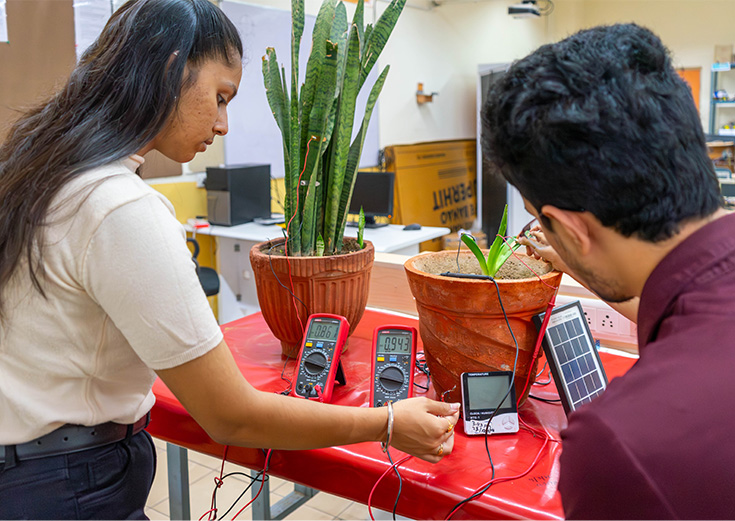
In a world where energy consumption is escalating at an alarming rate, the quest for sustainable and renewable energy sources has never been more critical. Energy harvesting emerges as a promising solution, offering the potential to harness ambient energy from the environment and convert it into usable power. The Energy Harvesting System Design (EHSD) Research Centre at NIIT University aims to develop new technologies that capture and convert energy from various renewable sources to power electronic gadgets.
Energy harvesting is the process of converting energy from renewable sources into usable electrical energy, known as clean energy or green energy, to power various electronic devices and gadgets to replace the hazardous battery in future. The choice of energy harvesting source depends on the specific application and the environment in which the device is used. This energy can be sourced from various renewable sources such as solar radiation, vibration, thermal gradients, wind, radiofrequency (RF) signals and living plants.
EHSD Research Lab has been working on developing new techniques to capture electrical energy from living plants and tress apart from sunlight or wind. The photosynthesis activity in trees and plant can be converted into usable electrical energy to power sensors autonomously with extended lifespans while reducing reliance on traditional power sources and minimizing environmental impact.
Computer Science & Engineering (CSE)
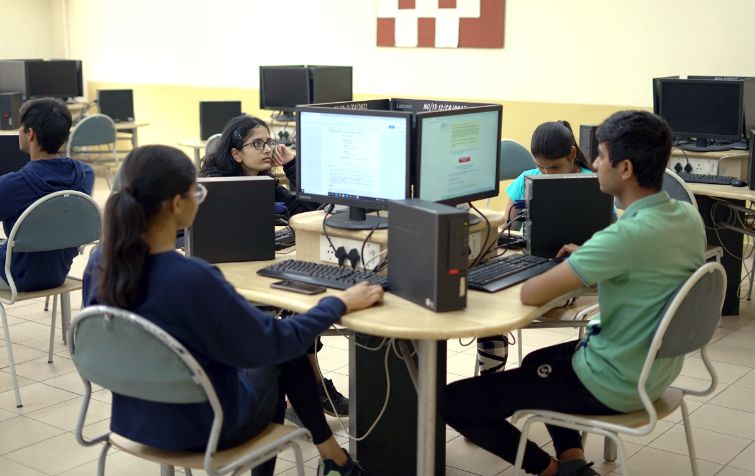
The IT and Software Engineering Labs are on NIIT’s Imperia network and equipped with the synchronous learning technique through which our students are exposed to a real-time learning environment. It gives a fantastic opportunity for industry and academia experts to interact online, thus reducing the constraints of time and space.
The entire computing infrastructure is connected by a high-speed network. Not only that, the entire campus, including the hostel rooms and faculty residences are connected to the campus-wide, wireless network with high-speed internet access for use by faculty members and students.
NU CSE students can confidently use JAVA, R, Python, MATLAB, and different simulators, Windows and Linux Operating Systems, ORACLE database, NoSQL databases like MongoDB, Neo4j, Cassandra, etc., for their Lab work. In the CSE Capstone project lab, students use DevOps Tools, Git & GitHub, MAVEN, JENKINS, Docker, Angular, API-Microservices and other CI/CD tools for their assigned project work.
Biotechnology (BT)
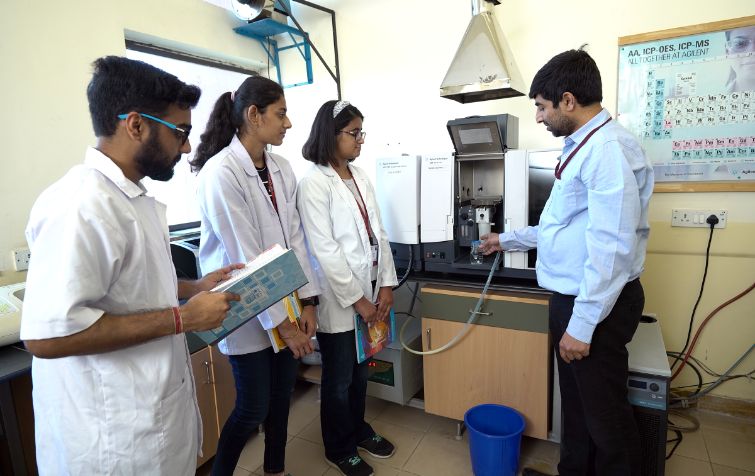
NU’s Biotechnology laboratories are equipped with state-of-the-art infrastructure to support laboratory courses, research projects, and doctoral research. The facilities ensure that students receive extensive hands-on training in modern biotechnology techniques while working in a well-equipped and professionally managed laboratory environment.
Each student is provided with adequate workspace, consumables, and access to advanced instrumentation necessary for experimental learning and research.
Biotechnology Laboratory Facilities
The Biotechnology infrastructure integrates molecular biology, microbiology, plant biotechnology, animal cell culture, bioinformatics, and bioprocess engineering within a unified laboratory ecosystem.
Molecular Biology & Microbiology
The lab is equipped with:
- Real-Time PCR systems
- Electroporator
- Gel electrophoresis and Gel documentation system
- -80°C, -20°C and 4°C storage freezers
- Anaerobic growth chamber
- Refrigerated and table-top centrifuges
- BOD and shaking incubators
- PCR
- Circulating temperature-controlled water baths
- Compound and inverted microscopes
Separate chemical and reagent preparation rooms are available for media, buffers, and solution preparation. Two dedicated laminar airflow rooms support aseptic microbial work.
Plant Tissue Culture Facility
A dedicated aseptic Plant Tissue Culture Facility supports:
- Micropropagation and in-vitro regeneration
- Callus induction and somatic embryogenesis
- Tissue culture of medicinal and economically important plants
- Genetic transformation studies
The facility includes laminar airflow cabinets, controlled photoperiod culture racks, growth chambers, sterilization systems, and media preparation units.
Animal Cell Culture Facility
A separate controlled facility supports animal cell culture studies and includes:
- Laminar airflow cabinet
- CO₂ incubator
- Inverted microscope
- Sterile storage and refrigeration units
This facility enables work in cellular biology, host–microbe interaction studies, molecular expression systems, and translational biotechnology applications.
Bioprocess & Fermentation Facility
The laboratory houses:
- Fermenter
- Constant temperature room (37°C) with shakers
- Ultra-sonicator
- Lyophilizer
- Shaking incubator with lighting for photosynthetic organisms
- Milli-Q water purification system
These facilities support large-scale microbial growth, fermentation studies, and downstream processing experiments.
Bioinformatics & High-End Computational Facility
To support computational biology research, NU provides a high-performance Bioinformatics Workstation configured for:
- Next Generation Sequencing (NGS) data analysis
- Genomics and transcriptomics
- Structural bioinformatics and molecular modeling
- Computer-aided drug discovery
- Systems biology and database development
The system features high-capacity processors, GPU-enabled support, and high-volume storage infrastructure for efficient large-scale data analysis.
Instrumentation Facility
The Instrumentation Room houses advanced analytical equipment including:
- High-Performance Liquid Chromatography
- Fast Protein Liquid Chromatography
- Gas Chromatography
- Atomic Absorption Spectroscopy
- UV-Visible and Fluorescent Microplate Readers
Students are trained to operate these instruments for qualitative and quantitative biochemical and molecular analysis.
Support Infrastructure
- Cold Room (4°C): For storage of heat-sensitive reagents, chromatography columns, mammalian cell culture media, and immunology kits.
- Distillation & Autoclaving Room: Equipped with large distillation units and automated autoclaves for media preparation and sterilization.
Physics
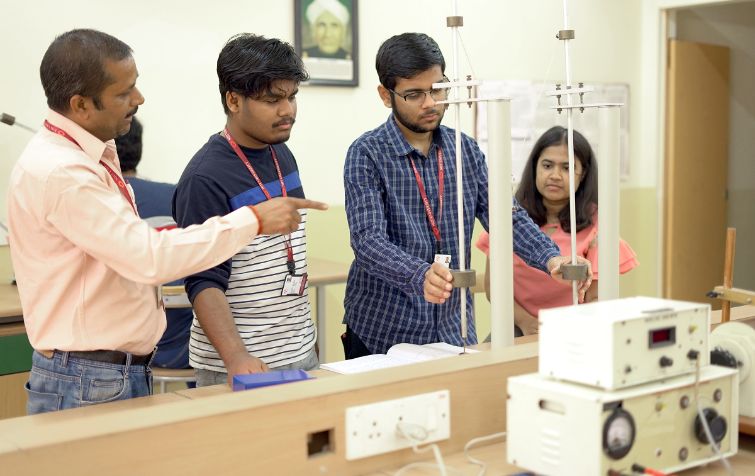
The Physics laboratory is equipped with modern equipment to carry out a wide range of experiments in almost all branches of Physics.
Chemistry
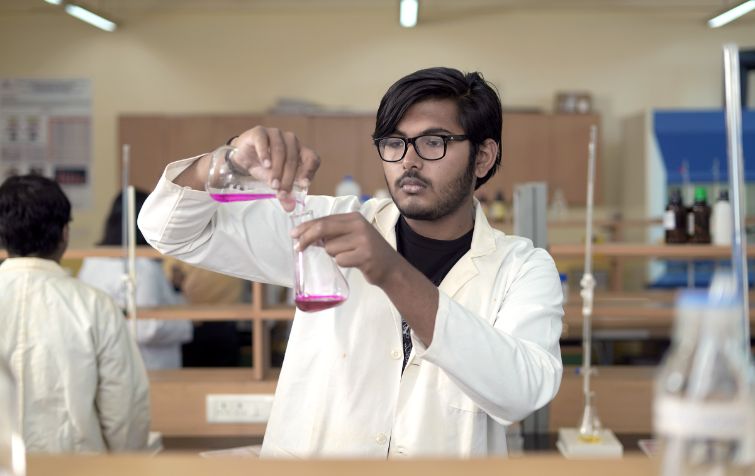
The Chemistry Laboratory at NU is equipped with essential modern instrumentation and facilities to support undergraduate and postgraduate experimental training. The laboratory provides a safe and well-ventilated working environment with dedicated fume hoods and organized chemical storage systems.
The facility houses precision instruments including electronic balances, pH meters, conductivity meters, muffle furnace, magnetic stirrer with hot plate, melting point apparatus, polarimeter, Ostwald viscometers, rotary vacuum evaporator, surface tension apparatus, chromatography units, high-pressure autoclave, and high-pressure vacuum oven. Adequate glassware and analytical setups are available to ensure accurate and reproducible experimental work.
The laboratory supports practical training in analytical, organic, inorganic, and physical chemistry, enabling students to gain hands-on experience in synthesis, quantitative analysis, physicochemical measurements, kinetics, chromatography, and high-pressure reactions.
The Chemistry laboratory in NU is well furnished with modern equipment including glassware, fume hoods, a muffle furnace, centrifuge, fume hood, electronic balance, bench water bath, polarimeter, Beckmann’s apparatus, Stalagmometer, Ostwald viscometer, M.P. apparatus, pH meter, chromatography equipment, high-pressure autoclave, and high-pressure vacuum oven. The Chemistry lab has all the resources to execute the following experiments including:
- Titration- Acid-base/ Oxidation-reduction (redox)
- Functional group determination
- Adulteration in food articles
- Synthesis of organic and inorganic compounds
- Quantitative estimations of metals
- Viscosity/surface tension determination
- Chemical kinetics
- Melting and boiling point determination
- pH measurement
- Chromatography
- Polarimetry experiments – Specific rotation
- High Pressure reaction
Educational Technology Lab
The Educational Technology Lab at NU is a dynamic space where learning sciences and digital innovation converge. As advancements in computing, mobile technologies, and web platforms reshape education, the lab enables students to design and evaluate technology-enabled learning solutions grounded in sound pedagogical principles.
Here, technology is treated as a means to enhance learning—not the mission itself. Students engage in applied research and system design to create impactful learning experiences that address cognitive, affective, and social dimensions of development. The Lab emphasises instructional design, assessment frameworks, interactive media creation, and scalable digital solutions across diverse platforms.
Through research-informed practice and hands-on development, students gain the capability to build meaningful, learner-centred products and learning ecosystems for schools, higher education institutions, corporate environments, and digital enterprises.
Cyber Security
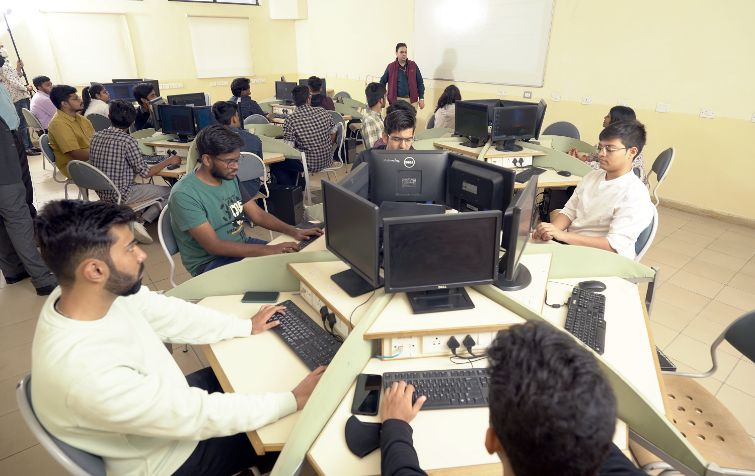
The systems are preconfigured with a list of tools like:
- Cisco Packet Tracer: To understand the working process of the devices and network topology
- Oracle Virtual Box: To create a virtual environment for the practical
- Nmap/Zenmap: Perform network scanning by CLI and GUI
- Wireshark: For the packets capturing and analysing
- Hping3: Packet crafting and arbitrary packet body and size
- Google Hacking: Use google hacking technique to gather the information
- Metasploit Framework: To exploit modules and used for penetration testing
- Acunetix: To find web vulnerabilities
- Nikto: For web server vulnerability scanning
- Netsparker: Demonstrate web application security needs
- Burp Suite: For Web application security
- SQLMAP: To find the SQL injection flaws
- KFSensor: For honeypot and IDS practice
- Snort: For Network Intrusion Detection System
- VeraCrypt: For disk encryption
- Wapiti: Command-line based vulnerability scanner
- Ettercap: Supports active and passive dissection and includes features for network and host analysis
- Savvius: Checks performance issues and reduces security risk with the deep visibility provided by Omnipeek. It can diagnose network issues faster and better with Savvius packet intelligence
- QualysGuard: Checks the performance vulnerability of cloud systems
- Nessus Professional: Check network vulnerability
- OWASP Zed: Automated scanners, as well as various tools that allow users to discover security vulnerabilities manually
- ProDiscover Forensic: To recover deleted files and access Windows alternate data streams
Along with these NU CSE has dedicated Virtual Labs for the MTech Cyber Security programme. The labs are categorised based on different areas of specialisation of the Cybersecurity master’s programme. A base machine with Ubuntu, 4vCPU 16 GB RAM 100 GB SSD with root access and In VirtualBox installed Kali, Win x, Metasploitable and administrative access is provided to respective Faculty members.
Lab-1 for Infra security and VM: Four cloud labs are configured under following subject areas with 25 individual Virtual Machines for individual students with proper access permission and preinstalled OS and tools:
- Vulnerability Assessment & Penetration Testing Lab
- Advanced Cyber Security Tools for INFRASEC & VM Lab
- Advance Network Security Lab
- Security Analytics Lab with R and RStudio, Python, Sublime text, D3.js, Git, MongoDB, Radis, Mahout on Ubuntu.
- Cyber Security Operations lab
- Advanced cyber security tools for Cyber Defence Operations lab
- IoT Security lab
- Threat Intelligence lab
- Security Analytics lab with R and RStudio, Python, Sublime text, D3.js, Git, MongoDB, Radis, Mahout on Ubuntu.
- Analytics and Big Data lab
- System and Network Security lab
- Platform and Cloud Security lab
- Cryptography lab
Data Science
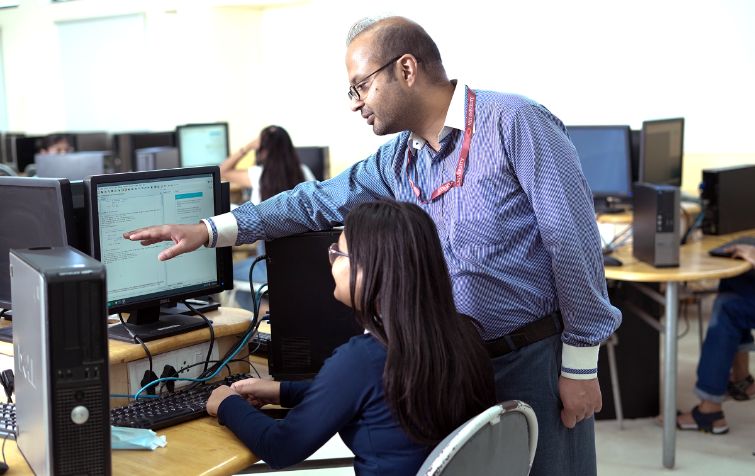
The Data Science Lab and Simulation Lab contains 68 and 32 high specification Lenovo and Dell systems (i7 processor, 16 GB RAM, 1 TB HDD) configured with Windows, Ubuntu operating systems. The entire computing infrastructure is connected by a high-speed network.
NU Data Science students are trained to use JAVA, R, Python, MATLAB, and different simulators, Operating Systems, NoSQL Databases like MongoDB, Neo4j, Cassandra during the course of their lab work.
The Bigdata Lab is enabled with components that collectively form a Hadoop ecosystem for students’ lab assignments, projects and research:
- HDFS: Hadoop Distributed File System
- YARN: Yet Another Resource Negotiator
- MapReduce: Programming based Data Processing
- Spark: In-Memory data processing
- PIG, HIVE: Query based processing of data services
- HBase: NoSQL Database
- Mahout, Spark MLLib: Machine Learning algorithm libraries
- Zookeeper: Managing cluster
- Apache Kafka: for high-performance data pipelines, streaming analytics, data integration, and mission-critical applications.
In the Data Science Capstone project lab, students use DevOps Tools, Git & GitHub, MAVEN, JENKINS, Docker, Angular, API-Microservices and other CI/CD tools. The R&D Project Lab is enabled with Deep Learning, Machine Learning, Lateral Language Processing, Computer Vision, Digital Image Processing, Predictive Modelling and optimisation tools and technologies to do research and development in different Data Science areas.
Digital Signal Processing Lab
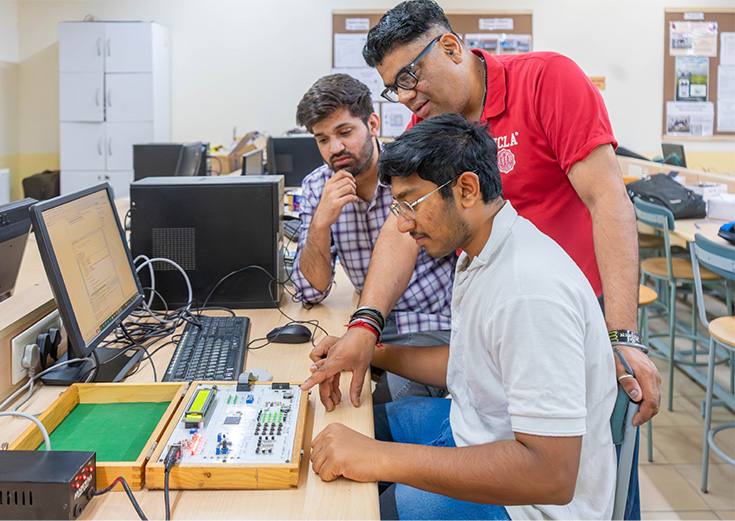
The DSP lab exposes students to various Algorithms and Simulation tools for design and realisation of Digital Filters using FFT. Students are given extensive practice on MATLAB using Signal Processing Toolbox. The lab is equipped with testing and measuring instruments like Digital Storage Oscilloscopes, Function/ Pulse Generators, microphones, headphones and speakers.
Microcontroller and Embedded Systems Lab
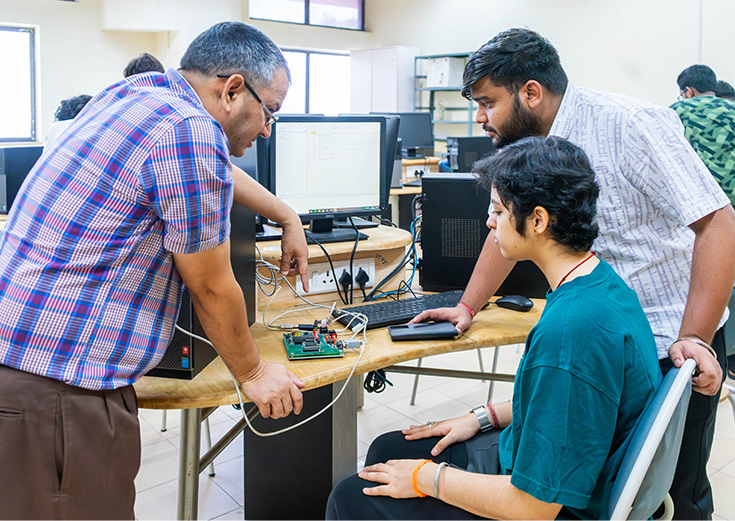
The Microcontroller and Embedded Lab contains 20 customised PCs configured with multiple operating systems such as Ubuntu 15, Windows 8, etc. Development environments such as MPLAB IDE, MDK 5 -the KEIL embedded tool for ARM are installed on every system.
The lab also contains customised kits for programming in different microcontroller architectures such as 8051, PIC and high-end processors such as ARM. The lab also has electronic equipment such as Logic Analyzers, Digital Storage, oscilloscope, etc., which are commonly used in Embedded Systems Design & Development.
Antenna and Microwave Propagation Lab
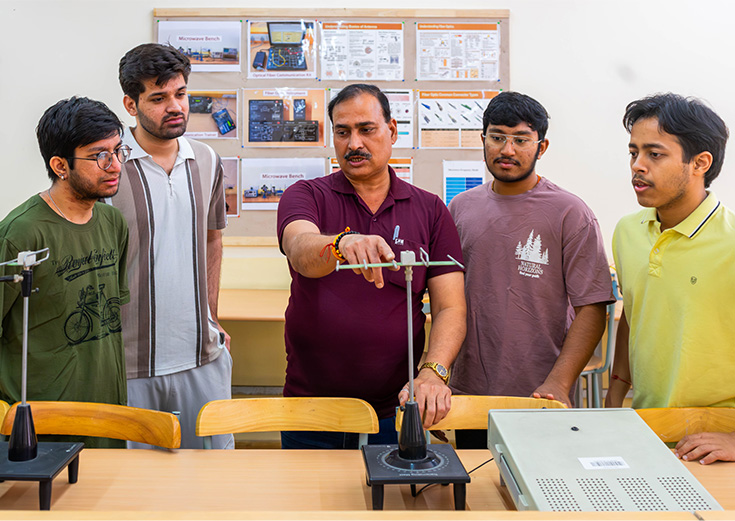
The passive devices include
- Wave guides
- Directional couplers
- E–Plane tee
- H-Plane Tee
- Magic Tee
- Isolator
- Circulator
- Attenuator
- Tunable probe
- Moveable short
- Terminations
- Simple dipole
- Folded dipole
- Yagi-Uda
- Hertz
- Zeppelin
- Log periodic
- Loop
- Rhombus
- Ground plane
- Slot
- Helix
Wireless Communication Lab
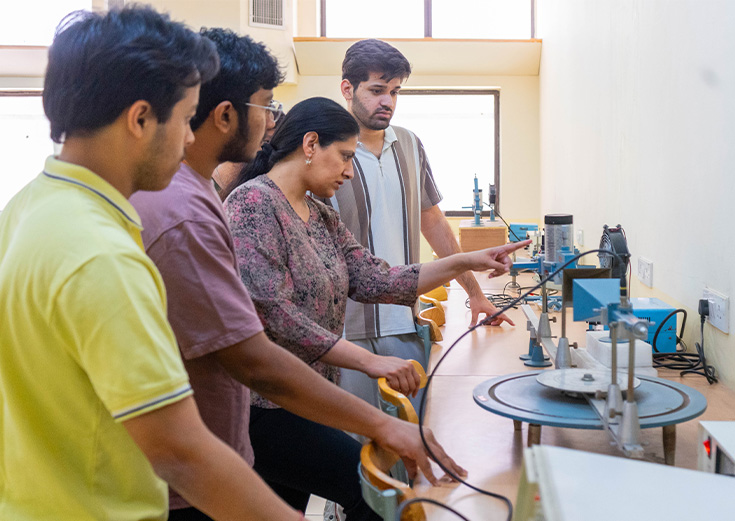
The Wireless Communication Lab contains 15 customised PCs configured with multiple operating systems such as Ubuntu 15, Windows 8, etc. MATLAB is installed on every system.
The lab contains tools for wireless networking using protocols such as Bluetooth, ZigBee, 6LoWPAN and BLE to conduct research work. The lab is also equipped with kits to demonstrate CDMA, Digital Modulation Techniques and Spread Spectrum Modulation Technology to students.
NU provides a state-of-the-art Wireless Communication Laboratory facility with cutting edge equipment for students taking the Electronics & Communication Engineering programme. The lab provides a platform for students to explore, study and analyse various advanced wireless communication technology concepts.
The lab is equipped with a high-end Spectrum Analyzer, Digital Storage Oscilloscope, Arbitrary Waveform Generator, DSP board, high gain horn antenna and various types of sensors to help students learn the concepts and scope of futuristic 5G network and its application towards IoT for advanced research.
Electronics Lab
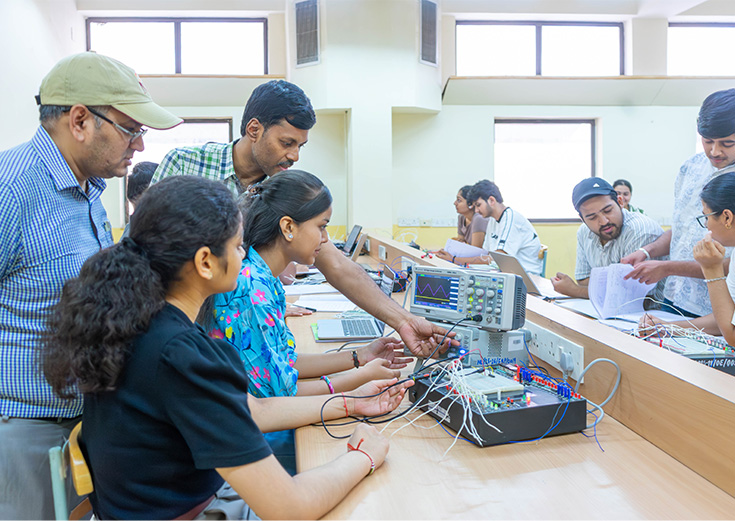
The labs are equipped with sufficient numbers of
- Advanced Embedded Systems boards
- Computer Numerical Control (CNC) Machines
- LASER engraving machine
- 3D Printer
- PCB Designing facilities
- Xilinx FPGA boards
- Digital Storage Oscilloscopes
- Spectrum Analyzer
- Embedded System boards
- Digital Electronics Trainer boards
- Function Generators
- Power Supplies
- Multimeters
It has a well-stocked store of discrete components and integrated circuits including micro-controllers, Analog and Digital ICs and different types of electronics components used under these courses. The students build their circuits from scratch on breadboards and printed circuits boards. It sharpens their assembling, testing and debugging skills with respect to analog and digital circuits.
Control Systems Lab
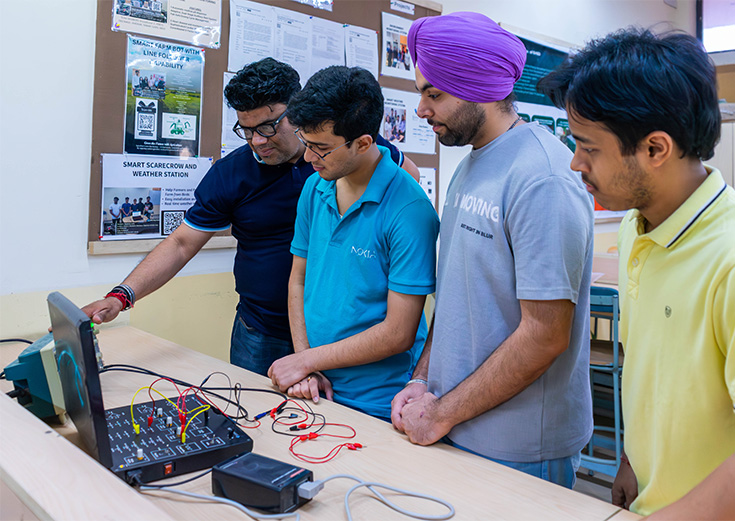
The lab is equipped with a PID controller kit and Compensator kits. It helps the students to implement the control Algorithms and Simulation tools for the design and realisation of the systems. A Control System Toolbox is installed on 15 customised PCs configured with multiple operating systems such as Ubuntu 15, Windows 10. The lab is equipped with signal generators, oscilloscopes (25 MHz, 2 channels), DSO (50 MHz, 1 G Sa/sec) and logic analysers.
Analog Communications Lab
Digital Communications System Lab
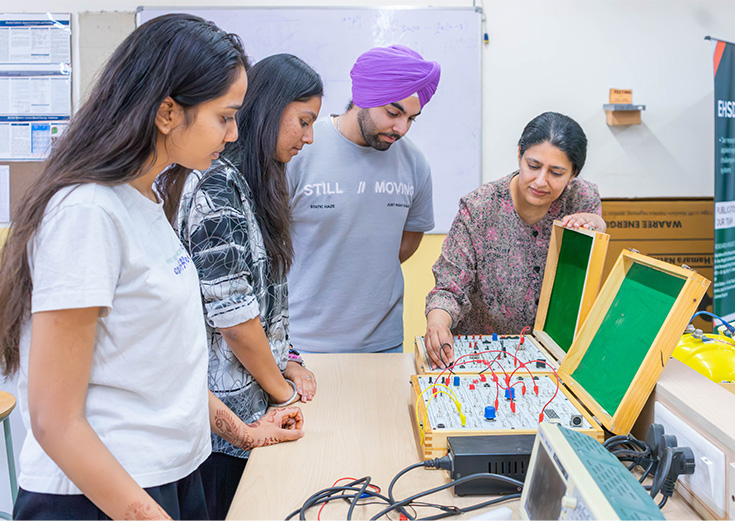
The Digital Communications System Lab has been equipped with cutting-edge instruments to perform experiments on various digital modulation techniques and for enabling the understanding of sampling theory. Advanced equipment and high-end system analysers enable the faculty to develop modulation techniques on their own.
Students can develop various digital and pulse modulation techniques and fabricate it at the product level. This lab equips the students to continue their journey towards advanced wireless communication systems and in various research and development work.
Digital Logic and Circuits Lab
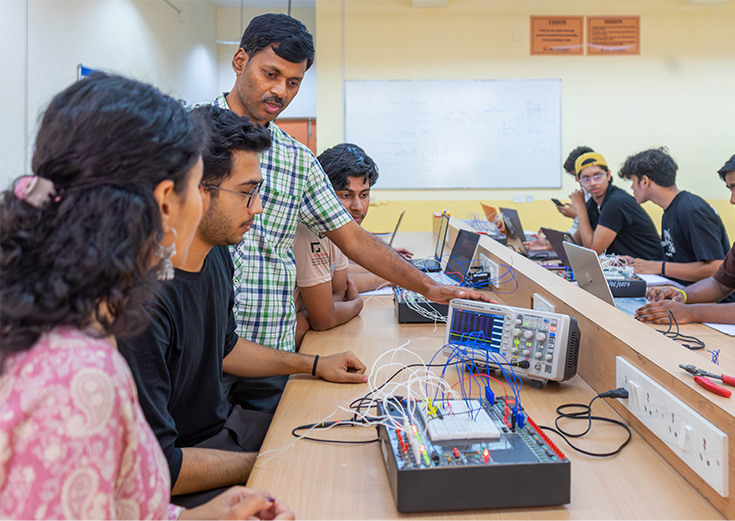
- Adder
- Multiplexer
- Encoders
- Decoders
- Flip-flop
- Latches
- Registers
Embedded Systems and VLSI Design Lab
FPGA kits (Spartan 3e and other peripherals) are available for designing the systems. ATMEL based AT89S52 development boards, Microchip based PIC16F877a development boards & ARM based STM32F103RB development boards, logic analyser and Ulink2-Keil ARM JTEG debug adapter are available in the lab. This lab is equipped with 30 high-end computers with updated OS and related software.
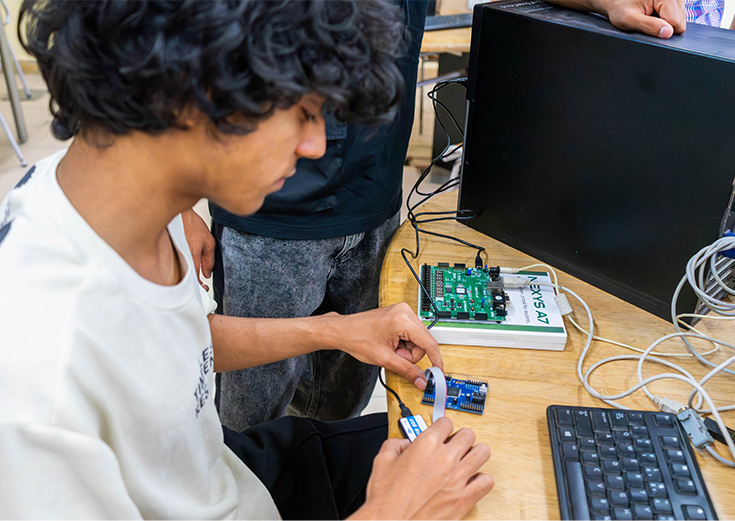
The Advanced VLSI Lab is equipped with 30 PCs and modern FPGA boards for digital IC design and testing. LTSPICE, an open source tool, is used to simulate analog circuits. All PCs are configured with the latest Integrated Development Environment (IDE) for architectural design and testing of ICs.
The lab facilitates low-power, high-frequency and area-optimised architecture design and development. Students and scholars get to work with the latest-in-the-industry tools here.
Optical Communications Lab
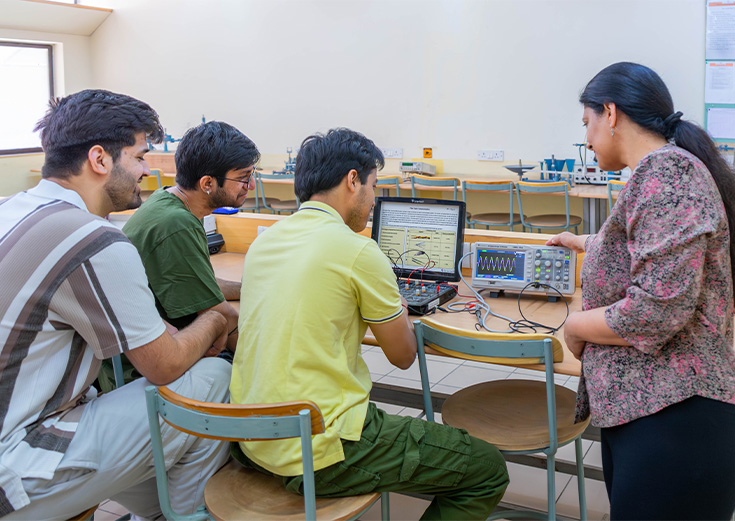
Moreover, the lab has the facility to demonstrate the working of key optoelectronic devices like Light Emitting Diodes, LASERs and Photodiodes and to analyse their performance characteristics. The lab also has a fusion splicer where students can learn to splice the fibres for different optical networking applications.
Satellite Communications lab
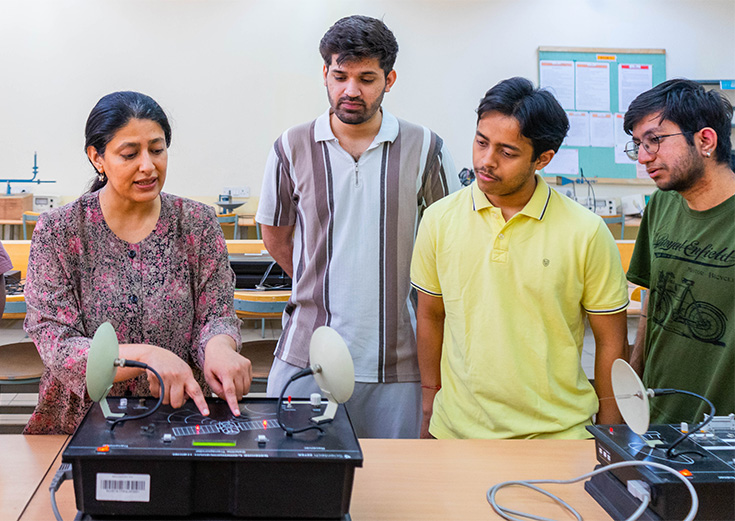
Wireless Communication Lab
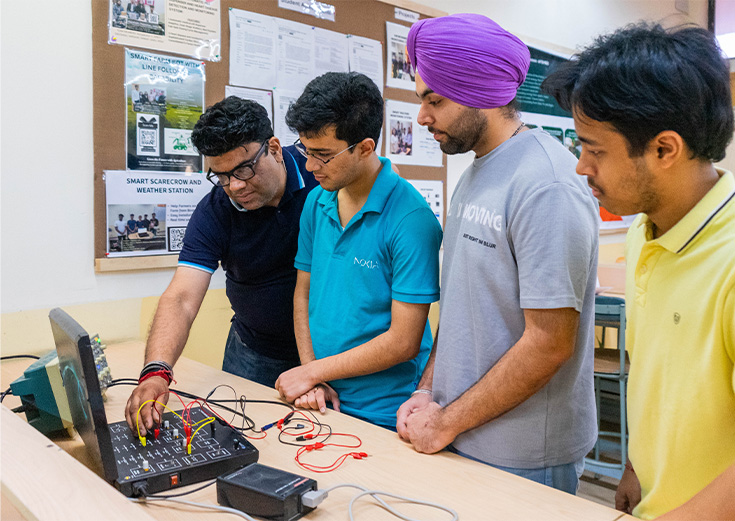
NU provides a state-of-the-art Wireless Communication Laboratory facility with cutting edge equipment for students taking the Electronics & Communication Engineering programme. The lab provides a platform for students to explore, study and analyse various advanced wireless communication technology concepts.
The lab is equipped with a high-end Spectrum Analyzer, Digital Storage Oscilloscope, Arbitrary Waveform Generator, DSP board, high gain horn antenna and various types of sensors to help students learn the concepts and scope of futuristic 5G network and its application towards IoT for advanced research.
Workshop Practice Lab
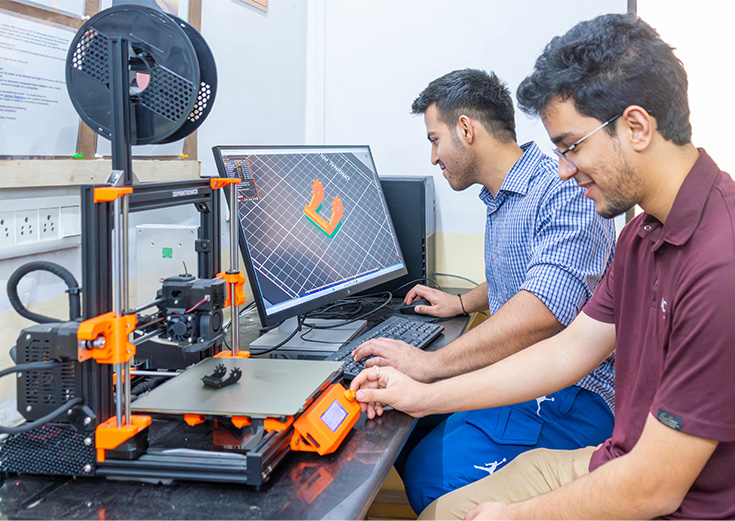
The Workshop Practice Lab supports students to get practical knowledge of several workshop practices such as PCB Designing Schematic & layouts, filming, etching, drilling, soldering and testing, lathe, sheet metal work, machining, etc., and to learn the safety regulations required to be maintained on a shop floor.
There are additional experimental setups related to CNC machining, PCB development, etc., which helps students to enhance their knowledge. Students also get the opportunity to implement their ideas through various application oriented micro projects.
- 3D printing
- LASER engraving machine
Geographic Information Systems
GIS Lab
NU’s GIS Lab is equipped with the following hardware, software, surveying instrument, and cloud-based platforms:- Hardware:
- High configuration computer workstations for each student equipped with required accessories. The workstations have excellent storage facilities along with high-speed processors.
- The GIS lab offers high end computer systems for the students to work on 3D applications with high quality graphics, 3D mouses and 3D Glass kits.
- ESRI CityEngine Advanced
ArcGIS Desktop Advanced (ArcGIS Pro and ArcMap):- 3D Analyst
- Data Interoperability
- Data Reviewer
- Geostatistical Analyst
- Network Analyst
- Publisher
- Schematics
- Spatial Analyst
- Tracking Analyst
- Workflow Manager
- Software
This plays an important role in building 3D models of buildings, road network and utility services. - QGIS
Open-Source software for primary and advanced 2D mapping. - SNAP
Open-Source software from European Space Agency (ESA) plays an important role in working with Sentinel-1 Synthetic Aperture Radar (SAR) datasets and optical datasets. - Surveying and lab instruments:
NU’s GIS lab contains a series of advanced GPS receiver devices to carry out field surveys. It is also equipped with photogrammetry instruments including Mirror Stereoscope and other instruments. - Cloud Based platforms
- ArcGIS Online Standard and premium applications such as:
- ArcGIS Earth
- Explorer for ArcGIS
- Web Mapping Apps
- Collector for ArcGIS
- Survey123 for ArcGIS
- Operations Dashboard for ArcGIS
- Workforce for ArcGIS
- ArcGIS Maps for Adobe Creative Cloud
- ArcGIS Maps for Office
- Esri Maps for SharePoint
- Web AppBuilder for ArcGIS
- Story Maps and Web App Templates
- AppStudio for ArcGIS Basic
- Business Analyst web and mobile apps
- Community Analyst
- GeoPlanner for ArcGIS
- Insights for ArcGIS
- Google Earth Engine (GEE)
A cloud-based platform where we can access, visualise, analyse and export the Landsat, Sentinel, MODIS satellite datasets, Elevation datasets and many more advanced applications. - Programming languages
Students are trained in the theoretical and practical aspects of Python and JavaScript. Machine learning and Artificial intelligence-based R&D projects using these languages will give students the experience of real-world application of such popular fields.
IoT and Robotics Lab
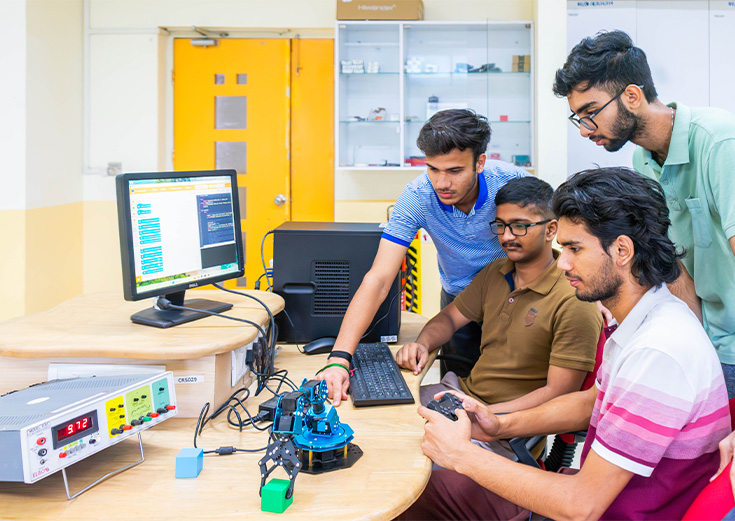
The IoT and Robotics Lab provides a hands-on environment where students explore the integration of intelligent systems, connected devices, and autonomous machines to solve real-world problems. The lab enables learners to design and develop smart IoT applications using sensors, embedded systems, and cloud platforms, while also building and programming robotic systems capable of perception, decision-making, and actuation. Through project-based learning and experimentation, students gain practical experience in areas such as automation, computer vision, machine learning, and cyber-physical systems. The lab encourages innovation, interdisciplinary collaboration, and the development of solutions for domains including smart homes, agriculture, healthcare, and industrial automation.
The labs are also stocked with the following:
- 3D Printer
- Industry grade Microcontrollers
- Industry grade Sensors and Actuators
- Robotics Design & Development Kits
- Mechatronics boards with programmers
- Digital Storage Oscilloscopes
- Function Generators
- Power Supplies