
 NU is all about fresh perspectives. So is our website.
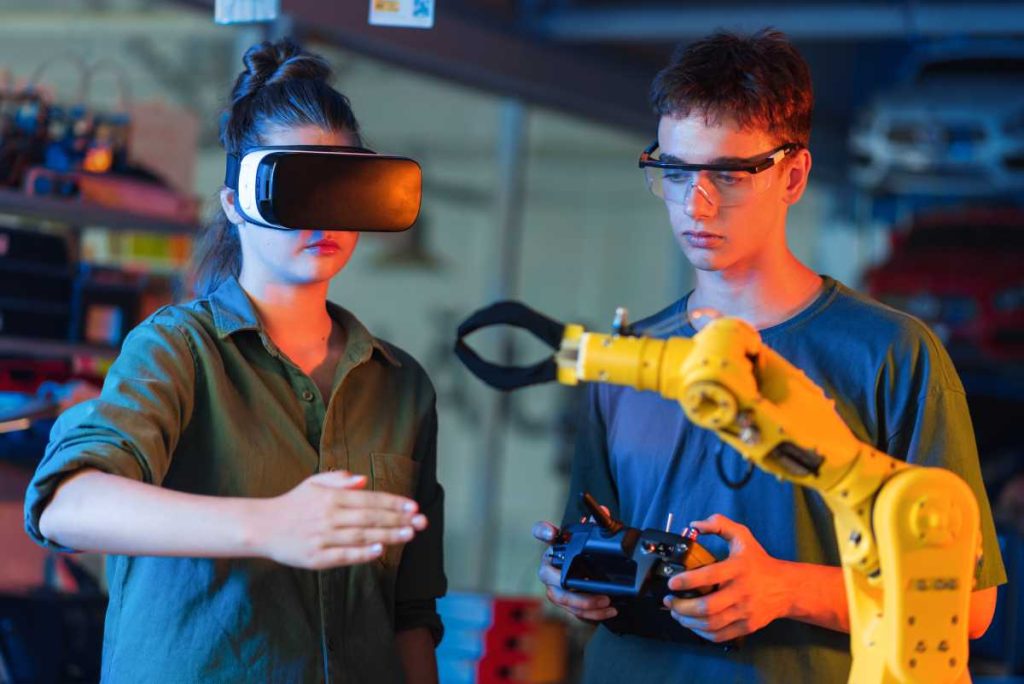
If you have ever searched for a career in tech, you have probably come across the terms Robotics and Artificial Intelligence in the same breath. They are often used interchangeably, but they are fundamentally different within their respective disciplines. Understanding this distinction is not just academic trivia; it could shape the entire trajectory of your engineering career. At NIIT University, both fields are taught with depth and purpose, equipping students for the technology-driven world of tomorrow.
This blog breaks down what Robotics and AI really mean, how they differ, where they intersect, and how NIIT University prepares students to thrive in both.
Robotics is the branch of engineering and science focused on designing, building, programming, and operating robots — machines that can physically interact with the real world. Robotics draw from multiple disciplines, including mechanical engineering, electrical engineering, computer science, and control systems.
A robot does not necessarily need to “think” — it simply needs to perform tasks. Early industrial robots, for example, were programmed to do precise, repetitive actions like welding or assembly, without any capacity for decision-making. The focus on robotics is on physical construction, actuation, sensors, and the mechanics of movement.
Artificial Intelligence (AI) is about building systems that can think, learn, reason, and make decisions — often in ways that mimic human intelligence. AI does not require a physical body or machine; it lives in software. A recommendation engine on a streaming platform, a fraud detection system at your bank, or a chatbot handling customer service — these are all AI in action.
AI encompasses subfields like machine learning (ML), deep learning, natural language processing (NLP), and computer vision. The focus is on pattern recognition, data interpretation, and autonomous decision-making based on algorithms and neural networks.
While both fields overlap in exciting ways, their core distinctions are important to understand:
Here is where it gets truly exciting. When robotics and AI converge, they give birth to a new category: intelligent automation. These are machines that can perceive their environment, process information, make decisions, and act — all without continuous human input.
Think about self-driving cars: they use sensors and actuators (robotics) combined with machine learning and computer vision (AI) to navigate roads autonomously. Smart manufacturing plants use AI-powered robots that adapt their actions based on real-time data. In healthcare, surgical robots powered by AI can assist doctors with precision that surpasses human capability.
This intersection is not just a technological curiosity — it is one of the fastest-growing areas of the global economy, and it is creating an enormous demand for skilled professionals who understand both worlds.
NIIT University (NU) offers two distinct yet complementary programmes that let students build deep expertise in either — or both — of these domains.
This programme is designed for students who want to build, program, and operate the machines that are reshaping industries. The curriculum covers robotics fundamentals, embedded systems, control engineering, mechatronics, and automation technologies. Students learn to work with real robotic systems and industry-standard tools, gaining the hands-on skills that employers in manufacturing, aerospace, defence, and logistics are actively seeking.
For those drawn to the intellectual side — to making machines smart — NIIT University’s AI and Data Science programme offers a rigorous curriculum in machine learning, deep learning, neural networks, data analytics, and intelligent systems. Students develop the mathematical and computational foundation to build AI systems that can learn from data and solve complex problems across sectors including finance, healthcare, retail, and technology.
What sets NIIT University apart is its commitment to practical, industry-relevant education. Students across both programmes benefit from extensive lab work, collaborative research projects, and a structured Industry Practice component — real-world engagements with leading technology organisations where students apply their knowledge to live problems.
This approach ensures that by the time students graduate, they are not just theoretically prepared — they have demonstrable experience with the tools, platforms, and workflows used by top companies in the tech industry.
The honest answer is that it depends on where your passion lies.
The career landscape for graduates in both fields is expansive and growing. Here is a snapshot of where each path can take you:
Robotics graduates can pursue roles as Robotics Engineers, Automation Specialists, Control Systems Engineers, Embedded Systems Developers, and R&D Engineers in sectors like automotive, aerospace, manufacturing, and defence.
AI & Data Science graduates can pursue roles as Machine Learning Engineers, Data Scientists, AI Researchers, NLP Engineers, and Business Intelligence Analysts across industries including finance, healthcare, e-commerce, and tech startups.
With the global robotics market projected to reach hundreds of billions of dollars in the coming decade, and AI integration accelerating across every sector, professionals with expertise in either domain — or both — are among the most sought-after in the world.
Robotics and AI are distinct but deeply complementary fields. One builds the body; the other builds the mind. Together, they are redefining what machines can do — and what humans can achieve through technology.
At NIIT University, students are not just taught to understand these technologies — they are trained to create with them. Whether your goal is to engineer the next generation of autonomous robots or to build the intelligent systems that power them, NIIT University provides the academic foundation, practical exposure, and industry connections to make that vision a reality.
Robotics and AI are separate disciplines that can work together. Robotics focuses on building and operating physical machines, while AI focuses on creating intelligent, learning systems. When AI is applied to robots — enabling them to perceive, decide, and act autonomously — the result is called intelligent automation or AI-powered robotics. Not all robots use AI, and not all AI systems are embedded in robots.
Both fields have exceptional career prospects and are considered among the fastest-growing areas in technology. The “better” choice depends on your interests and strengths. AI offers broader applicability across virtually every industry, while Robotics offers deep specialisation in physical automation and systems engineering. The most powerful careers in the coming decades will likely belong to professionals who understand the intersection of both.
A Robotics Engineer designs, builds, and programmes for physical machines — working with hardware, sensors, actuators, and embedded systems. An AI Engineer focuses on developing algorithms, neural networks, and machine learning models that allow systems to learn and make intelligent decisions. While their skill sets can overlap — especially in intelligent robotics — their day-to-day work and tools are typically quite different.
NIIT University (NU) offers a BTech in Robotics and Automation and a BTech in AI and Data Science. The Robotics programme covers embedded systems, control engineering, and automation, while the AI programme focuses on machine learning, neural networks, and intelligent systems. Both programmes include Industry Practice components and hands-on lab experience.
Yes. While the two programmes are distinct, NIIT University’s curriculum is designed to expose students to both fields, especially at their intersection in intelligent automation. Students in either programme have access to cross-disciplinary coursework, research projects, and collaborative industry exposure that helps them understand how Robotics and AI complement each other in real-world applications.