
 NU is all about fresh perspectives. So is our website.
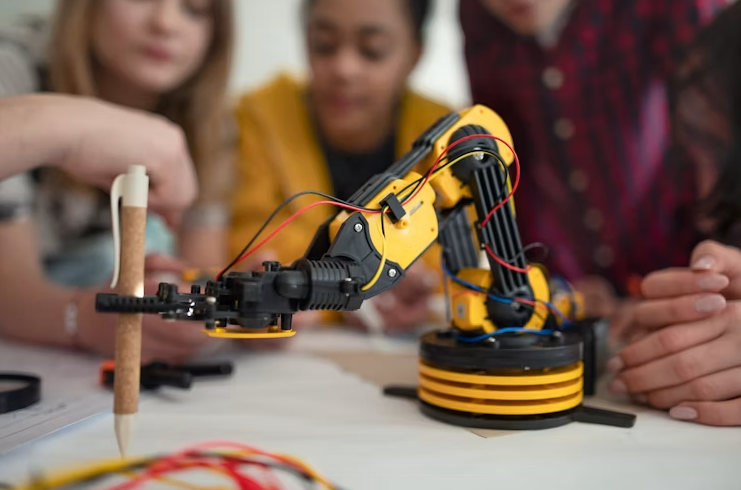
A decade ago, Artificial Intelligence was viewed as a specific technology that was discussed primarily in research laboratories and at technology conferences. Nowadays, however, Artificial Intelligence has already become ubiquitous: this technology is used in virtual assistants, recommendation engines, health diagnostics, autonomous vehicles, and many other devices. As Artificial Intelligence evolves further, however, an even greater revolution is going to take place soon. What will happen once intelligent systems go beyond software and start interacting with the physical world?
The answer to this question can be found in Robotics Engineering.
With a variety of industries moving toward automation and intelligent technologies, Robotics Engineering appears to be one of the most promising and impactful engineering disciplines of the future. Whereas Artificial Intelligence was teaching machines how to think, Robotics Engineering teaches them how to act. Thus, by combining these technologies, intelligent systems capable of solving real-world problems and working together with people start to appear.
Why Is Robotics Engineering Becoming One of the Most Important Careers of the Future?
Imagine an intelligent robot helping doctors during a lifesaving surgery, providing assistance with incredible precision. Imagine autonomous robots operating huge warehouses that process millions of customers’ orders daily. Imagine intelligent machines exploring deep oceans, disaster zones, and conducting research in distant planets.
All of these are not some futuristic concepts anymore. They have started to turn into our reality already.
Global transformation towards automation, intelligent manufacturing, and smart technologies increases the need for people who understand robotics and automation systems enormously. Businesses invest a lot of resources into robotics to increase productivity, improve accuracy, improve safety at workplaces, lower costs, compensate for workforce shortages, and to accelerate innovation.
With the emergence of Industry 5.0 – collaboration between people and intelligent machines leading to the achievement of better results – Robotics Engineering becomes a key factor of technological evolution.
What Is Robotics Engineering?
Robotics Engineering is an interdisciplinary field uniting Mechanical Engineering, Electronics, Artificial Intelligence, Computer Science, and Automation Technologies with the purpose of designing, developing, and managing intelligent machines.
The main goal of Robotics Engineering is simple but powerful: creation of machines able to execute tasks fast, accurately, efficiently, and flexibly. Unlike old machines that could only operate according to predetermined instructions, modern robotic systems are capable of sensing the environment, analyzing information, making decisions, and executing actions autonomously.
Today robotics goes far beyond factories. Intelligent robotic systems are transforming healthcare, transportation, agriculture, defense, logistics, retail, and education. With the development of new technologies, Robotics Engineering continues to expand its influence on nearly all spheres of the global economy.
Why Should Students Consider Robotics Engineering Today?
One of the most common questions that students ask while considering future careers is whether a certain discipline will remain relevant within the next decade. In case of Robotics Engineering, however, the question seems to be reversed: can the future exist without robotics?
Answer to this question becomes more and more obvious: probably not.
As technologies of autonomous vehicles, intelligent manufacturing systems, smart cities, and healthcare automation are developing rapidly, robotics becomes an integral part of people’s everyday life. All technologies of the future have the same four key features: ability to sense, to analyze, to decide, and to act. Robotics Engineering takes its place at the intersection of all these features.
Such unique position of Robotics Engineering makes it one of the most future-ready engineering disciplines today. Those students who choose this field are preparing for the careers which will remain relevant as industries evolve in the direction of automation and intelligent technologies.
How Robotics and Automation Are Transforming Industries
One of the most common misconceptions regarding robotics is that robots can be found only in manufacturing environments. The reality is much more interesting, however.
In the field of healthcare, robotic-assisted surgeries increase precision and improve patient outcomes, while rehabilitation systems and intelligent patient monitoring technologies change the approach to delivering medical care. In manufacturing, robotics allows to create smart production systems, quality inspection systems, predictive maintenance systems, and to increase operational efficiency.
The sector of logistics experiences the emergence of autonomous warehouses, delivery robots, and automation systems for increasing the speed and accuracy of operations. In agriculture, robotics becomes the source of innovations like precision farming, automated harvesting, and crop monitoring technologies aimed at improving food production and sustainability.
In aerospace, robotics is used for space explorations, autonomous drones, satellite servicing, and scientific missions. These examples show how robotics and automation create opportunities in industries which have nothing to do with robotics traditionally.
What Will You Study in Robotics Engineering?
One of the main attractions of Robotics Engineering is its interdisciplinary nature. Students gain expertise in several engineering and technology fields, thus forming very diverse skill sets.
Typically, the curriculum of Robotics Engineering studies includes such disciplines as Robotics Fundamentals, Artificial Intelligence, Embedded Systems, Control Systems, Machine Learning, Sensors and Actuators, Computer Vision, Automation Technologies, and Industrial Robotics.
Such combination of fields allows students to understand how intelligent machines perceive the environment, analyze information, make decisions, and operate. Practicality of Robotics Engineering gives the opportunity to work with real-world projects, prototypes, automation systems, and innovative technologies.
Career Opportunities in Robotics Engineering
One of the major reasons why students start choosing Robotics Engineering is wide diversity of career opportunities which this field can provide.
Increasing demand for robotics and automation technologies from businesses leads to increasing demand for specialists in this area. Graduates may pursue careers as Robotics Engineers (who are responsible for designing and developing of robotic systems), Automation Engineers (creators of intelligent automation solutions), Robotics Programmers (developers of software for robotic applications), Autonomous Systems Engineers (creators of self-operating technologies), and AI Robotics Specialists (developers of integration between Artificial Intelligence and robotic systems).
Other careers can include positions of Industrial Robotics Engineer (optimization of manufacturing automation) and Research Engineer (development of new robotic technologies). As the adoption of robotics increases globally, such careers become more and more valuable.
Is Robotics Engineering One of the Top Engineering Courses for the Future?
While choosing between various engineering courses offered nowadays, students should consider three important factors: demand in the future, innovation potential, and career diversity.
Robotics Engineering scores very high in all these categories. This field faces the strong demand due to the need of businesses in automation and intelligent technologies. Innovation potential of Robotics Engineering is great because this field defines the interaction between machines and the physical world. Finally, it gives the opportunity to get jobs in manufacturing, healthcare, aerospace, defense, automotive, agriculture, logistics, and other technology sectors.
It is hard to find another engineering discipline with such powerful combination of relevance, creativity, and growth potential.
The Skills That Will Define Successful Robotics Engineers
Professional success in Robotics Engineering requires not only technical skills, but also the ability to combine them with creative thinking and innovation.
Programming skills, robotics system design, Artificial Intelligence, Machine Learning, automation technologies, and electronics are the core of this discipline. Other skills include such professional competencies as critical thinking, collaboration, adaptability, communication, and innovation.
The most successful Robotics Engineering professionals will be those people who will be able to combine advanced technology and human needs, thus creating innovative solutions which will transform industries and improve people’s lives.
Future Outlook: What Will Robotics Engineering Look Like in 2035?
Next decade will completely restructure the relationship between humans and machines. According to experts, there will be rapid growth in Human-Robot Collaboration, Intelligent Manufacturing, Autonomous Mobility, Smart Cities, Healthcare Robotics, Industrial Automation, and AI-Powered Robotics spheres.
Due to the increasing convergence of technologies, distinction between Robotics Engineering, Artificial Intelligence, and Automation will disappear gradually. Innovations of the future will arise from the intersections of these fields, creating intelligent ecosystems capable of solving the most complex global problems.
Such convergence is one of the main reasons why students should consider Robotics Engineering as one of their future careers.
The Future Belongs to Builders of Intelligent Machines
Each technological revolution creates its own defining careers. The era of the Internet created Software Engineering. Smartphone revolution created mobile application development careers. The era of Artificial Intelligence created Machine Learning and Data Science careers.
The next revolution belongs to Robotics Engineering and intelligent automation.
Those students who enter Robotics Engineering today are not just going to take part in the future: they are going to create it. The world needs builders of intelligent systems capable of transforming industries, improving people’s lives, and solving some of the most complex challenges of humanity.
As technologies of intelligent systems become an integral part of society, Robotics Engineering will continue to shape the future of how we live and work. For those students who seek future-proof engineering discipline combining creativity, technology, innovation, and impact, Robotics Engineering offers one of the greatest opportunities of the modern era.
The Future Will Be Built by Those Who Can Turn Intelligence Into Action
Artificial Intelligence taught machines how to learn.
Robotics Engineering is teaching them how to move, interact, assist, and transform the world around us.
For students seeking a future-proof career at the intersection of innovation, technology, and real-world impact, Robotics Engineering offers an opportunity unlike any other.
The next decade will belong to those who can build intelligent systems that solve meaningful challenges.
The question is not whether robotics will shape the future.
The question is whether you will help shape the field of robotics.
Explore Robotics Engineering Programmes and Take the First Step Towards Building the Technologies of Tomorrow.
Robotics Engineering is a multidisciplinary engineering field that combines mechanical systems, electronics, computer science, artificial intelligence, and automation technologies to design, develop, and manage intelligent robotic systems.
Yes. Robotics Engineering is emerging as one of the fastest-growing fields because it applies Artificial Intelligence in real-world environments. As industries adopt robotics and automation technologies, demand for skilled professionals is expected to rise significantly.
Graduates can pursue careers as Robotics Engineers, Automation Engineers, Robotics Programmers, AI Robotics Specialists, Autonomous Systems Engineers, Industrial Robotics Engineers, and Research Engineers across multiple industries.
Robotics and automation improve productivity, precision, safety, and efficiency across manufacturing, healthcare, logistics, agriculture, aerospace, and smart infrastructure. Organizations are increasingly integrating intelligent machines into everyday operations.
Yes. Robotics Engineering is widely considered one of the top engineering courses because it combines Artificial Intelligence, automation, electronics, and mechanical systems while offering strong future demand and diverse career opportunities.