
 NU is all about fresh perspectives. So is our website.
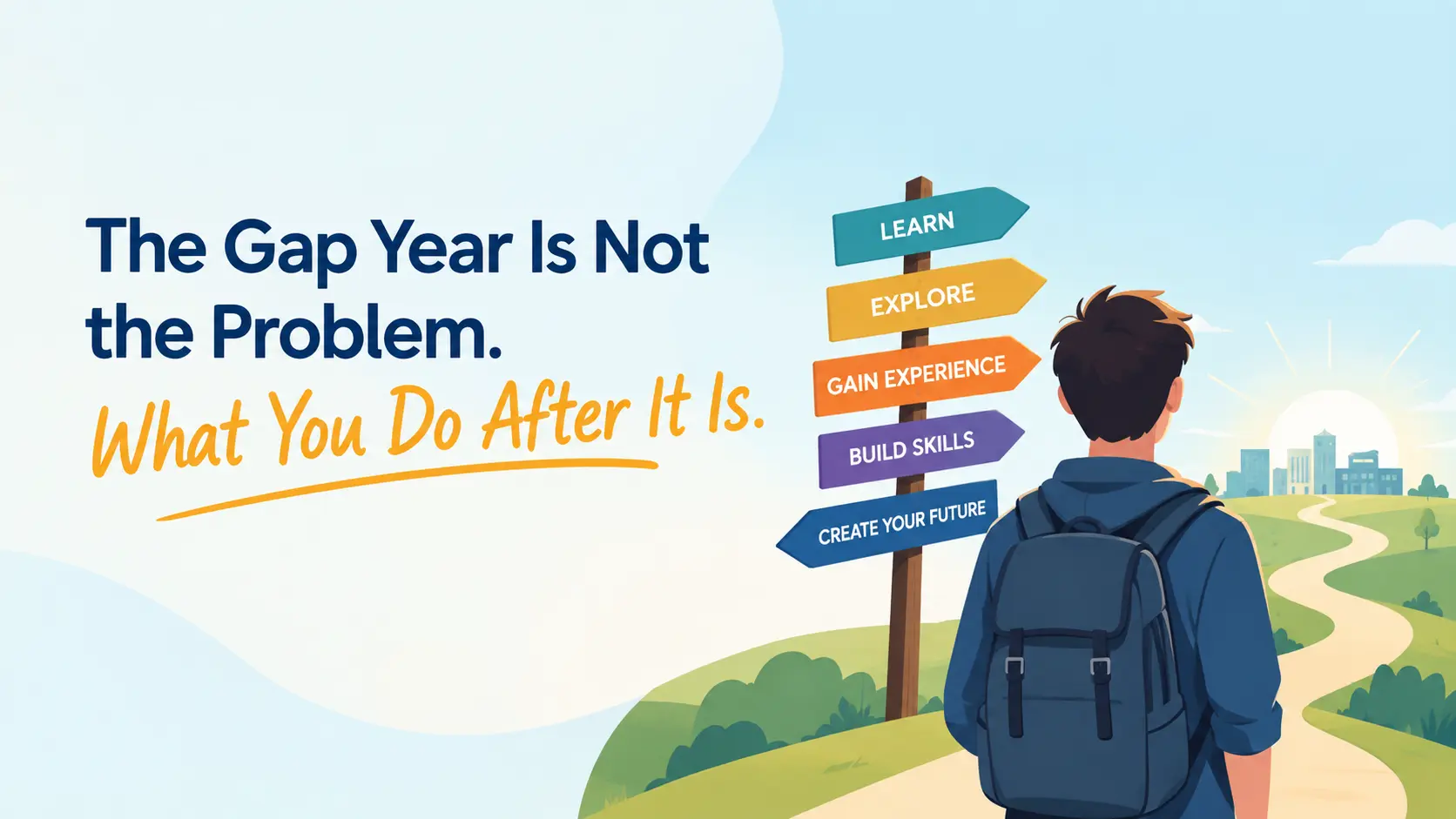
For a student who has spent an entire year preparing for an entrance examination, the result can create an unexpected second test: What do I do now?
The exam is over. Perhaps the expected rank did not come. Perhaps the result was good, but not good enough for the college originally imagined. Or perhaps the student simply realised that the career they were preparing for at 17 is no longer the career they want at 18.
And suddenly, a year spent preparing for one examination has to be followed by one of the most consequential decisions of their life: Which university? Which programme? Which career?
This is where many students and parents make their next mistake. They start searching for the “highest-paying course” or the “best college” as if either exists independently of the student’s capabilities.
It doesn’t.
A gap year taken to prepare for an entrance examination is not necessarily a setback. It can demonstrate discipline, persistence and the ability to work towards a difficult goal. But there is a danger in allowing the entrance examination to become the entire definition of success.
An entrance exam measures performance at a particular point in time. It does not measure the entire career potential of a 17- or 18-year-old.
The mistake is to treat one examination result as a verdict on the student’s future.
It isn’t.
The more important question is: What should the student build over the next four years?
That question matters because the employment market the student enters in 2030 will look very different from the one they see today. The World Economic Forum’s Future of Jobs Report 2025 estimates that 39% of workers’ existing skill sets could be transformed or become outdated between 2025 and 2030. AI and big data, networks and cybersecurity, and technological literacy are among the fastest-growing skills, while analytical thinking, creativity, resilience, leadership and collaboration remain critical.
The message is clear: the future will not belong to students who simply have a degree. It will belong to students who can keep becoming useful.
This is why the question “What is the highest-paying job of the future?” is the wrong starting point.
There is no responsible way to predict a single highest-paying job in 2030. Technology changes roles, industries create new ones, and today’s lucrative skill can become tomorrow’s baseline expectation. The WEF currently identifies Big Data Specialists, FinTech Engineers, AI and Machine Learning Specialists and Software Developers among the fastest-growing roles globally, alongside cybersecurity and green-transition roles.
So the smarter question for a student returning from a gap year is:
“Which combination of skills will make me difficult to replace and easy to employ?”
That changes how a student should look at a programme.
A student choosing Computer Science should not think only about becoming a software developer. They can think about CSE + AI, CSE + cybersecurity, CSE + cloud, CSE + product development or CSE + entrepreneurship.
A Biotechnology student should not think only about conventional laboratory careers. They can explore Biotechnology + bioinformatics, Biotechnology + computational biology, Biotechnology + AI or Biotechnology + data science.
An Electronics and Communication student can look beyond traditional electronics towards semiconductors, VLSI, embedded systems, robotics and connected technologies.
A management student, meanwhile, needs to recognise that tomorrow’s business leaders will increasingly need to understand data, technology, AI and digital transformation, alongside finance, strategy and leadership.
The university therefore becomes more than the place where a student earns a degree.
It becomes the environment in which that degree is converted into capability.
This is why parents and students should compare universities on more than rankings and placement headlines. Ask whether students work on real projects. Ask about internships and industry interaction. Look at research opportunities, hackathons, entrepreneurship, clubs, competitions and interdisciplinary learning. Most importantly, ask what a student will actually be able to do after four years—not simply what degree they will hold.
Universities such as NIIT University are part of this broader movement towards industry-linked, experiential and interdisciplinary undergraduate education. The value of this approach is not that it promises a particular salary; it is that it gives students more opportunities to connect classroom learning with real-world problems.
And this matters because the degree alone is increasingly insufficient.
Mercer’s India Graduate Skill Index 2025 reported that only 42.6% of Indian graduates assessed were overall employable, while employers increasingly value critical thinking, communication and learning agility alongside technical capabilities.
For a student beginning university after a gap year, therefore, the four-year plan should include more than examinations.
Learn to code. Learn to analyse data. Learn to use AI responsibly. Learn to communicate. Learn to present. Learn to work in teams. Build projects. Take internships. Participate in competitions. Understand business. Build something that can be demonstrated—not merely mentioned on a résumé.
The objective is not to master everything.
It is to become demonstrably capable at something valuable.
Parents also play a role in this decision. A gap year can create anxiety: “We have already lost one year. We cannot afford another wrong decision.”
But that anxiety can sometimes push families towards another poor choice—selecting a course because it sounds prestigious, safe or high-paying.
One year is a relatively small investment compared with spending the next four years in a programme that does not match the student’s interests, strengths or ambitions.
The right response to a gap year is therefore not urgency without thought.
It is better to think because of the experience.
Before joining a university, every student should be able to answer five simple questions: What kind of problems do I want to learn to solve? Which industries are likely to need those capabilities? What technical and human skills will I need? How will this university help me build them? And what will I be able to demonstrate four years from now?
If those answers are clear, the gap year becomes part of the story—not its definition.
Because the real objective after Class 12 is not to recover a year.
It is to invest the next four years intelligently.
And perhaps the most important career lesson after an entrance examination is this:
You do not need to predict the highest-paying job of 2030.
You need to become the kind of graduate who can adapt when 2030 arrives.