
 NU is all about fresh perspectives. So is our website.
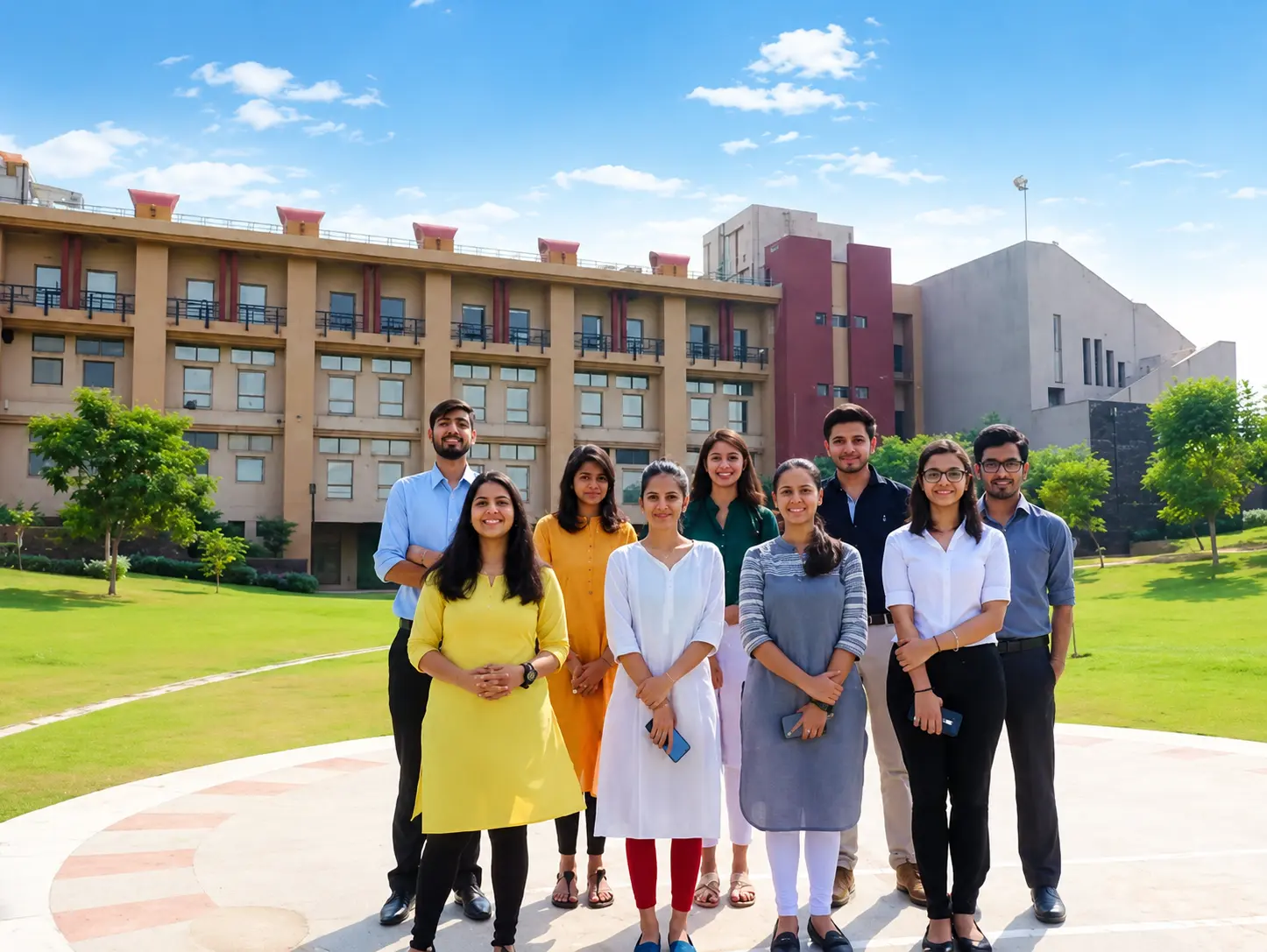
For today’s Class 12 students, choosing a university is no longer simply about finding a BTech programme, getting a degree and waiting for placements. The world they are preparing to enter is changing faster than ever. Artificial Intelligence is transforming industries, cloud platforms are reshaping enterprise technology, automation is changing jobs, and employers increasingly want graduates who can apply knowledge, solve problems and work with real-world technologies.
That is why students searching for the top private universities near Delhi NCR should ask a different question.
Not just: “Where should I study engineering?”
But:
“Where will I learn the technologies, skills and ways of working that the industry will expect from me four years from now?”
This is where choosing a private university near Delhi NCR becomes more than an academic decision. It becomes a career decision.
When comparing the top private universities near Delhi NCR, students should look beyond rankings, infrastructure and advertised packages.
The first question should be about the curriculum. Does the university offer contemporary engineering programmes? Can students explore Artificial Intelligence, Data Science, Cybersecurity, Robotics, Electronics, Biotechnology and other emerging fields?
The second question should be about learning by doing. Are students working on projects? Are real industry problems incorporated into their learning? Can they undertake internships? Do they interact with industry professionals?
The third question should be about career readiness. Does career preparation begin in the final year—or does it become part of the student’s journey from the beginning?
For students comparing engineering universities near Delhi NCR, these questions can reveal much more than a simple ranking.
Students researching the best private universities near Delhi NCR can explore a range of institutions, each with its own academic strengths, programmes and learning environment.
| University | Areas Students Can Explore | Key Factors to Compare |
|---|---|---|
| NIIT University | CSE, AI & Data Science, Biotechnology, ECE | Industry Practice, Additive Curriculum, AI-focused learning, industry projects, internships and career development |
| Bennett University | CSE, AI, ECE, Electronics & Computer Engineering, Mechanical, Biotechnology | Technology programmes, industry exposure and interdisciplinary opportunities |
| Shiv Nadar University | CSE, Electrical & Computer Engineering, Mechanical, Civil, Chemical Engineering and related disciplines | Research, interdisciplinary learning and academic environment |
| VIT | CSE, AI & ML, AI & Data Engineering, Cyber Security, Data Science and other engineering disciplines | Programme breadth, specialisations, research and industry opportunities |
| Sharda University | CSE, Data Science, AI/ML, Robotics, ECE, Biotechnology and other disciplines | Specialisations, practical learning and campus ecosystem |
| Parul University | Engineering, CSE, AI, Data Science, Robotics, Cybersecurity and other emerging areas | Programme breadth, practical exposure and industry integration |
| Amity University | CSE, AI, AI & Data Science, Robotics & AI, Biotechnology and other technology disciplines | Specialisations, research and industry exposure |
| DIT University | CSE, AI/ML, Data Science, Cybersecurity, Robotics, ECE and other disciplines | Emerging technology pathways, projects and internships |
| Lovely Professional University | CSE, AI/ML, ECE, Robotics, Biotechnology and other engineering disciplines | Programme diversity, projects, internships and career preparation |
This comparison is intended as a student decision guide rather than a ranking. Programme offerings can change, so students should always verify the latest information directly with each university.
For students exploring engineering universities near Delhi NCR, NIIT University presents a particularly industry-oriented model of undergraduate education.
Its BTech ecosystem includes Computer Science and Engineering, Artificial Intelligence and Data Science, Biotechnology, and Electronics and Communication Engineering. The university describes its programmes as industry-linked, technology-based, research-driven and experiential.
But the interesting part is what happens inside the curriculum.
At NU, industry exposure isn’t positioned simply as something students do after completing their academic learning. The university’s Additive Curriculum integrates real-time industry projects into courses, with industry mentors working alongside faculty. Projects can involve students across different years and disciplines.
In simple terms:
The industry problem becomes part of the learning.
That changes the traditional classroom model from:
Learn → Exam → Degree → Job
to a more experiential journey:
Learn → Apply → Build → Solve → Experience → Become Career-Ready
The Additive Curriculum is a pedagogical approach that differentiates the NIIT University learning model.
Instead of treating industry projects as something completely separate from academic courses, NU integrates value-adding experiential learning into coursework. According to NU, real-time industry projects are linked to courses, with faculty and industry mentors working together to guide students.
For a young student, this can make an important difference.
Imagine learning a technology concept in class and then seeing how that concept contributes to an actual industry problem.
That is the kind of learning experience students should look for when evaluating BTech colleges near Delhi NCR.
The AI conversation has also moved beyond simply learning Python, machine learning concepts or theoretical algorithms.
Students increasingly need exposure to the infrastructure and tools used to build AI systems.
NIIT University’s AI Centre of Excellence brings this dimension into the learning environment, highlighting hands-on learning using enterprise-grade GPU infrastructure and NVIDIA-powered AI technologies. NU describes students gaining practical exposure to real-world AI projects from the early stages of their education.
This matters for students considering AI and Data Science courses because AI education is not only about understanding concepts.
It is also about learning how to experiment, build, train, test and apply AI systems.
For a student thinking about an AI career, the question is therefore not merely:
“Does my university teach AI?”
It should be:
“Will I actually get opportunities to build with AI?”
Another development at NIIT University is its partnership with ServiceNow, an AI platform for business transformation.
In July 2026, NIIT University announced an MoU with ServiceNow to integrate industry-focused learning pathways into its BTech programmes. The partnership covers areas including AI, advanced computing, cloud platform development and enterprise technologies, with learning pathways involving ServiceNow certifications and exposure to Agentic AI.
The significance for students is straightforward.
Enterprise technology is not something they should encounter for the first time after graduation.
The closer the tools used in education are to the tools students may encounter in professional environments, the more connected the learning experience can become.
This is particularly relevant for students exploring emerging career options, where the technology landscape can change substantially during a four-year degree.
The journey doesn’t stop with projects and technology.
NIIT University’s flagship Industry Practice gives students the opportunity to work on real-time organisational problems under the mentorship of industry professionals and university faculty. NU states that it has built partnerships with more than 833 industry partners since inception.
Students can undertake Industry Practice through different curricular architectures, including a six-month final-semester Industry Practice, a one-year Industry Practice pathway or a one-year Research Practice pathway.
This creates a progression that can be particularly valuable for students:
Classroom → Projects → Internships → Industry Practice → Career
For students comparing engineering colleges near Delhi NCR, understanding this progression may be more useful than looking at placement numbers in isolation.
Students searching for the best engineering colleges near Delhi NCR for placements naturally want to know where graduates go after university.
But a better approach is to understand how students become placement-ready.
Look for career counselling, internships, project experience, technical preparation, communication skills, resume development, mock interviews and industry interaction.
At NIIT University, Industry Practice bridges academic learning and professional experience, with students working on real-world problems before graduation. The university also highlights career development and industry mentoring as part of its broader employability approach.
The principle is simple:
Placement should be the outcome of career preparation—not the beginning of it.
There is no universal answer to which of the top private universities near Delhi NCR is right for every student.
Instead, create a personal checklist.
Ask:
What will I study?
What technologies will I work with?
What will I build?
How many opportunities will I have for internships?
Will I work on real industry problems?
Can I customise my learning?
How will the university prepare me for placements?
What will my four-year career journey look like?
These questions can help students move beyond the generic search for the best private universities near Delhi NCR and identify the university that aligns with their own ambitions.
The most valuable university experience is not simply four years of lectures and examinations.
It is four years of learning, building, experimenting, collaborating, failing, improving, discovering and becoming career-ready.
That is the philosophy behind NIIT University’s emphasis on industry-linked education, Additive Curriculum, practical learning, Industry Practice and emerging technologies. NU also provides students opportunities to customise aspects of their curriculum, undertake projects and pursue internships.
For a generation entering an AI-driven workplace, this kind of learning ecosystem raises an important question:
When technology changes tomorrow, will you only know what you were taught—or will you know how to keep learning?
That may ultimately be one of the most important questions to ask while choosing among the top private universities near Delhi NCR.
If you are comparing BTech colleges near Delhi NCR, don’t choose based only on a ranking, campus photographs, or a placement headline.
And look at what you could become by the time you graduate.
At NIIT University, the journey brings together technology-based learning, industry exposure, research, Additive Curriculum, AI-focused infrastructure, ServiceNow’s enterprise technology learning pathways and Industry Practice.
Your BTech degree is four years. Your career is much longer. Choose an education that prepares you for both.
Students can explore NIIT University, Bennett University, Shiv Nadar University, VIT, Sharda University, Parul University, Amity University, DIT University and Lovely Professional University, among others. Students should compare programme fit, curriculum, industry exposure, internships, campus environment, career support and cost rather than relying on one ranking.
Look at curriculum relevance, faculty, laboratories, AI and emerging-technology exposure, industry projects, internships, research, placement preparation, campus life and opportunities to build practical skills.
Yes. NIIT University offers BTech in Artificial Intelligence and Data Science. Its undergraduate portfolio also includes Computer Science and Engineering, Biotechnology, Electronics and Communication Engineering.
Additive Curriculum is NU’s pedagogical approach that integrates real-time industry projects into academic courses. Industry mentors and faculty work together, allowing students to connect classroom concepts with practical problems.
NIIT University’s AI Centre of Excellence provides students with hands-on exposure to enterprise-grade GPU infrastructure and NVIDIA-powered AI technologies, with an emphasis on practical AI projects.
In July 2026, NIIT University announced a partnership with ServiceNow to integrate industry-focused learning pathways into its BTech programmes, covering areas such as AI, advanced computing, cloud platform development, enterprise workflows and Agentic AI.
Industry exposure gives students opportunities to apply academic knowledge to real-world problems and develop technical and professional skills. NIIT University’s Industry Practice allows students to work on industry projects with university and industry mentorship.
Industry Practice is a flagship NU programme that allows students to work on real-time industry projects. NU currently describes multiple curricular architectures, including six-month and one-year Industry Practice options and a one-year Research Practice option.
Parents should consider academic quality, curriculum, industry exposure, internships, career support, placement transparency, student development, safety, accommodation, fees and the overall learning environment.
No. Placement outcomes are one important factor, but students should also consider the learning environment, internships, projects, industry exposure, research opportunities, skills developed and long-term career alignment.