 NU is all about fresh perspectives. So is our website.




When Industry and Academia Stop Being Separate Worlds
A university’s relevance cannot be measured only by what happens inside a classroom. The real test begins when students take what they have learned and encounter the complexity of the professional world—ambiguous problems, changing technologies, business constraints, deadlines, collaboration and the need to create solutions that work beyond an examination paper.
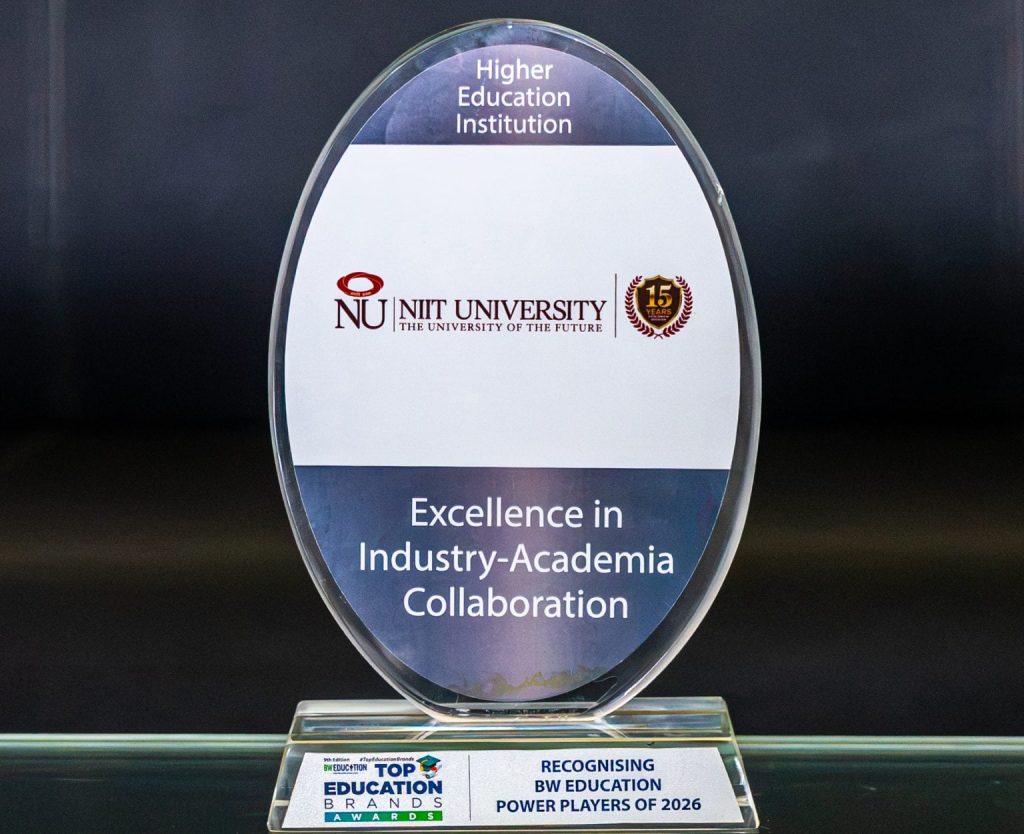
This is why meaningful industry-academia collaboration has become increasingly important in higher education. In 2026, NIIT University received the Excellence in Industry-Academia Collaboration Award at the 9th Edition of the BW Education Top Education Brands Summit & Awards 2026. The recognition acknowledged the university’s continued focus on building meaningful connections between industry and academia.
The award represents a larger question facing higher education today: How effectively can universities connect what students learn with the world they will eventually work in?
The workplace students enter after graduation is changing rapidly. AI is transforming tasks, data is influencing decision-making, and organisations increasingly expect graduates to combine technical knowledge with communication, adaptability and problem-solving. This makes the distance between university and industry an important educational question.
If students encounter real-world problems only after graduation, the transition from campus to career can be abrupt. Industry exposure during university can instead make professional learning part of the undergraduate experience.
NIIT University’s educational approach emphasises industry-linked learning, technology, research, and experiential education. The idea is to create an environment where students can connect classroom concepts with practical challenges and understand how their knowledge applies beyond academic assessments.
This philosophy becomes particularly relevant across programmes such as Computer Science and Engineering, Artificial Intelligence and Data Science, Biotechnology, Cybersecurity, Electronics and Communication Engineering and Integrated MBA. These disciplines are evolving rapidly, and students need opportunities to understand that evolution while they are still learning.
The significance of industry-academia collaboration is therefore not simply the number of partnerships a university can announce. The real question is whether those relationships create meaningful opportunities for students to interact with professionals, work on relevant problems, undertake projects, participate in internships or understand emerging industry requirements.
For students, meaningful industry exposure can provide context. For faculty, it can deepen understanding of changing professional needs. For industry, it can create stronger connections with future talent.
But collaboration matters only when it changes the student’s experience. A partnership on paper means little if students never encounter real-world problems or learn how professionals approach them. The real measure is what students can learn, build, experience, and demonstrate.
For NIIT University, the Excellence in Industry-Academia Collaboration Award 2026 represents this broader educational philosophy: creating stronger connections between learning and the world of work.
The workplace should not begin only after education ends.
Increasingly, it needs to become part of how education happens.