 NU is all about fresh perspectives. So is our website.




What Should Define a Top Private University?
The phrase “top university” is easy to use and surprisingly difficult to define. Is it rankings? Research? Faculty? Infrastructure? Industry connections? Student outcomes? Innovation? Or the ability to prepare students for careers that may look very different five years from now?
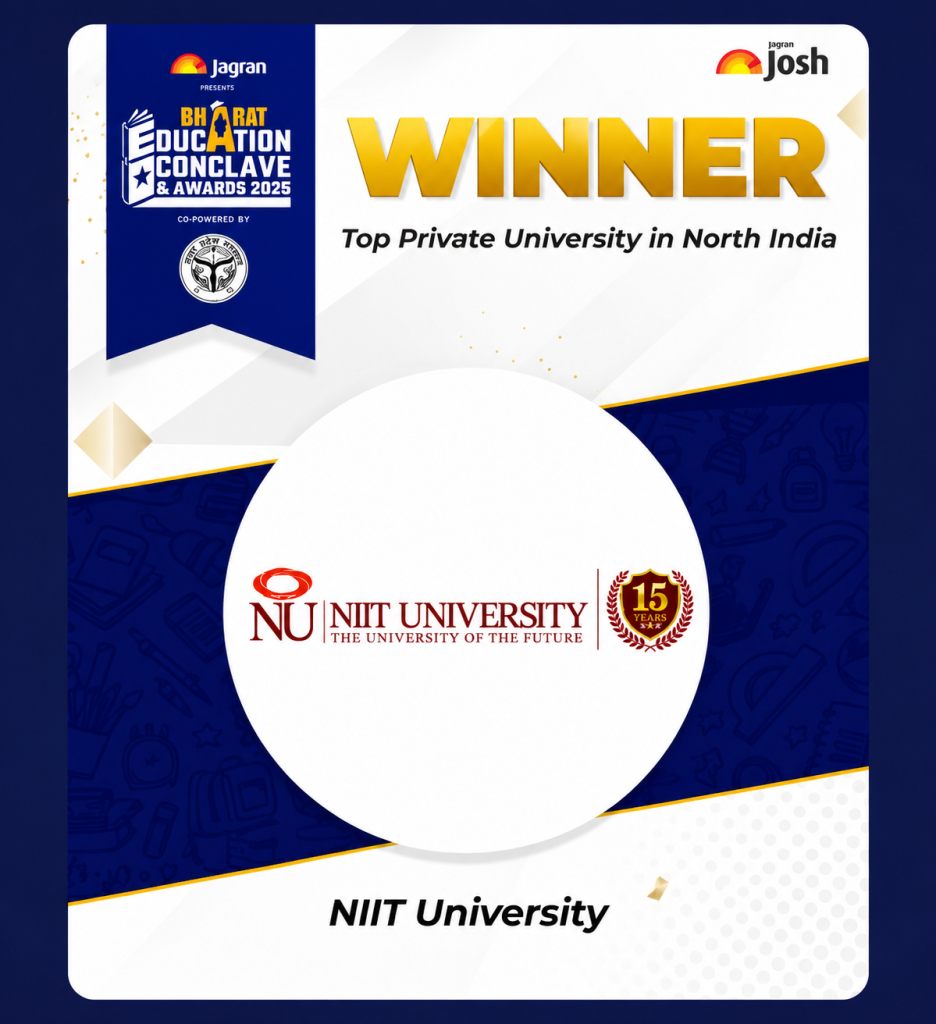
In 2026, NIIT University was recognised as the Top Private University in North India at the Bharat Education Conclave & Awards 2026, organised by Jagran.
The recognition comes at a time when the role of universities is changing significantly. Students are entering a world where technology is transforming industries, AI is changing professional roles, data is becoming central to decision-making, and interdisciplinary knowledge is becoming increasingly valuable.
A university, therefore, cannot simply be a place where students complete a prescribed curriculum. It must become an environment where students learn to apply knowledge, explore new ideas, work with others, and adapt to changing professional expectations.
NIIT University’s academic philosophy is built around four broad principles: Industry-linked, Technology-based, Research-driven and Seamless. These principles are reflected in an academic ecosystem that includes programmes in Computer Science and Engineering, Artificial Intelligence and Data Science, Biotechnology, Cybersecurity, Electronics and Communication Engineering, Robotics and Automation and Integrated MBA.
The significance of the recognition lies not simply in the title of “Top Private University”. It raises a more important question: What should a university actually prepare a student for?
The answer cannot be examinations alone. Students need opportunities to work on projects, interact with industry, participate in research, develop entrepreneurial thinking, collaborate across disciplines and gain exposure to real-world challenges.
Consider a student studying Computer Science. Their future may involve AI, cloud computing, cybersecurity or product development. A Biotechnology student may find opportunities at the intersection of biology, genomics, computation and AI. An electronics student may move towards semiconductors, embedded systems or robotics. A management student may need to understand technology and data alongside strategy and leadership.
The boundaries between disciplines are becoming less rigid. This makes the learning environment increasingly important.
For students and parents evaluating universities, rankings and recognitions can provide useful reference points. But they should be followed by deeper questions. What will the student actually learn? What will they build? What opportunities will they get outside the classroom? How much industry exposure will they receive? Can they explore disciplines beyond their core programme? Will they graduate with evidence of capability, not just a degree?
These questions ultimately determine the value of a university experience.
NIIT University’s recognition as the Top Private University in North India in 2026 is therefore more than an institutional accolade. It becomes part of a larger conversation about what modern higher education should look like.
A university should not simply prepare students for today’s jobs.
It should help them develop the ability to adapt to tomorrow’s.