 NU is all about fresh perspectives. So is our website.




Rankings Matter. But what they tell us matters more.
University rankings are among the first things students and parents look at when comparing institutions. And understandably so. A ranking provides a benchmark and offers a way to compare institutions across defined parameters.
But a ranking becomes genuinely useful only when we understand what it represents—and what it doesn’t.
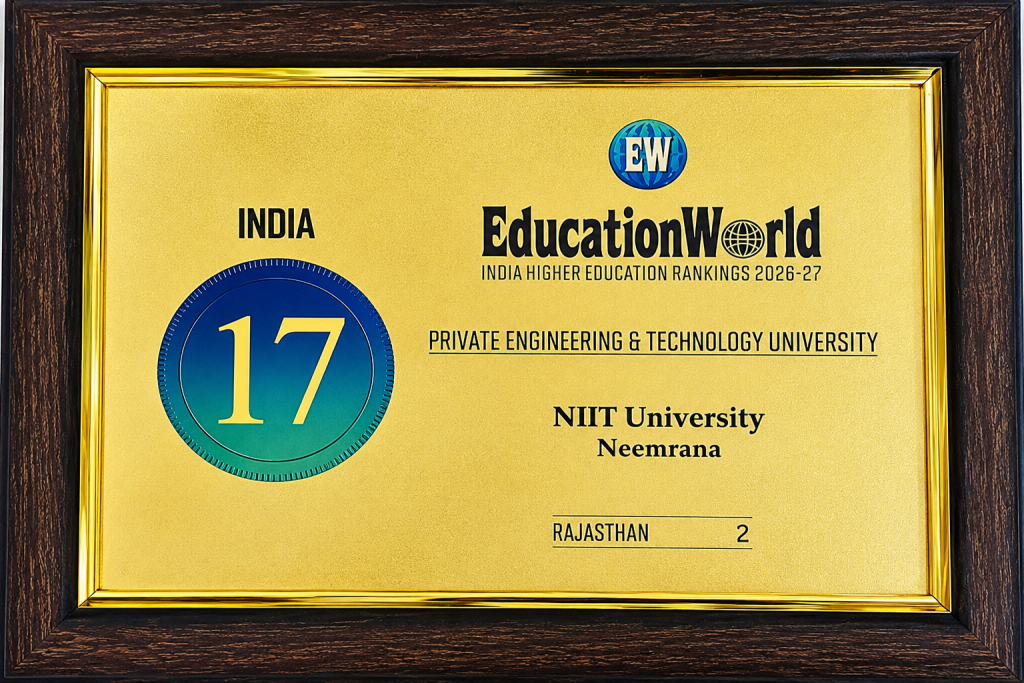
NIIT University ranked #2 in Rajasthan and #17 in India in the Private Engineering and Technology Universities category in the EducationWorld India Higher Education Rankings 2025–26.
The recognition provides an external reference point for the university’s position among private engineering and technology institutions. But the more interesting question is what lies behind a ranking.
Higher education is no longer being judged solely by traditional academic measures. Students want industry exposure. Parents want career readiness. Employers want graduates who can contribute. Faculty and researchers want environments that encourage inquiry and innovation. Students increasingly want opportunities to learn beyond their prescribed curriculum.
NIIT University’s educational approach is built around four principles: Industry-linked, Technology-based, Research-driven and Seamless.
Its academic portfolio spans Computer Science and Engineering, Artificial Intelligence and Data Science, Biotechnology, Cybersecurity, Electronics and Communication Engineering, Robotics and Automation, and Integrated MBA.
This reflects a broader shift across engineering and management education.
The boundaries between disciplines are becoming increasingly fluid. Computer Science is converging with AI and data. Biotechnology is intersecting with computation. Electronics is becoming central to robotics and intelligent systems. Management is becoming increasingly technology-driven.
Students are therefore not simply choosing a degree.
They are choosing an environment in which they will build capabilities.
This is why rankings should be treated as one input into a university decision, rather than the decision itself.
A student should still ask: What is the curriculum like? What are the faculty like? What kind of projects will I work on? Will I receive meaningful industry exposure? Are there research opportunities? Can I explore entrepreneurship? Will I have opportunities to participate in competitions and interdisciplinary activities?
Consider two students choosing between universities. One looks only at the ranking. The other asks: What will I learn? What will I build? Where will I gain experience? What skills will I have when I graduate?
The second student may ultimately make the more informed decision.
That does not make rankings irrelevant. External rankings provide useful benchmarks and can encourage institutions to continually evaluate and improve themselves. But for students, the number should be a starting point for research, not the end.
The #2 position in Rajasthan and #17 position nationally provide one measure of NIIT University’s standing among private engineering and technology universities.
The more important question for an individual student, however, is whether the university’s strengths align with their own ambitions.
Because ultimately, a ranking measures an institution.
A university experience shapes a student.
And those are two very different things.