“Every industrial revolution changed the way we worked. Artificial Intelligence is changing the way we think, create, innovate, and lead.”
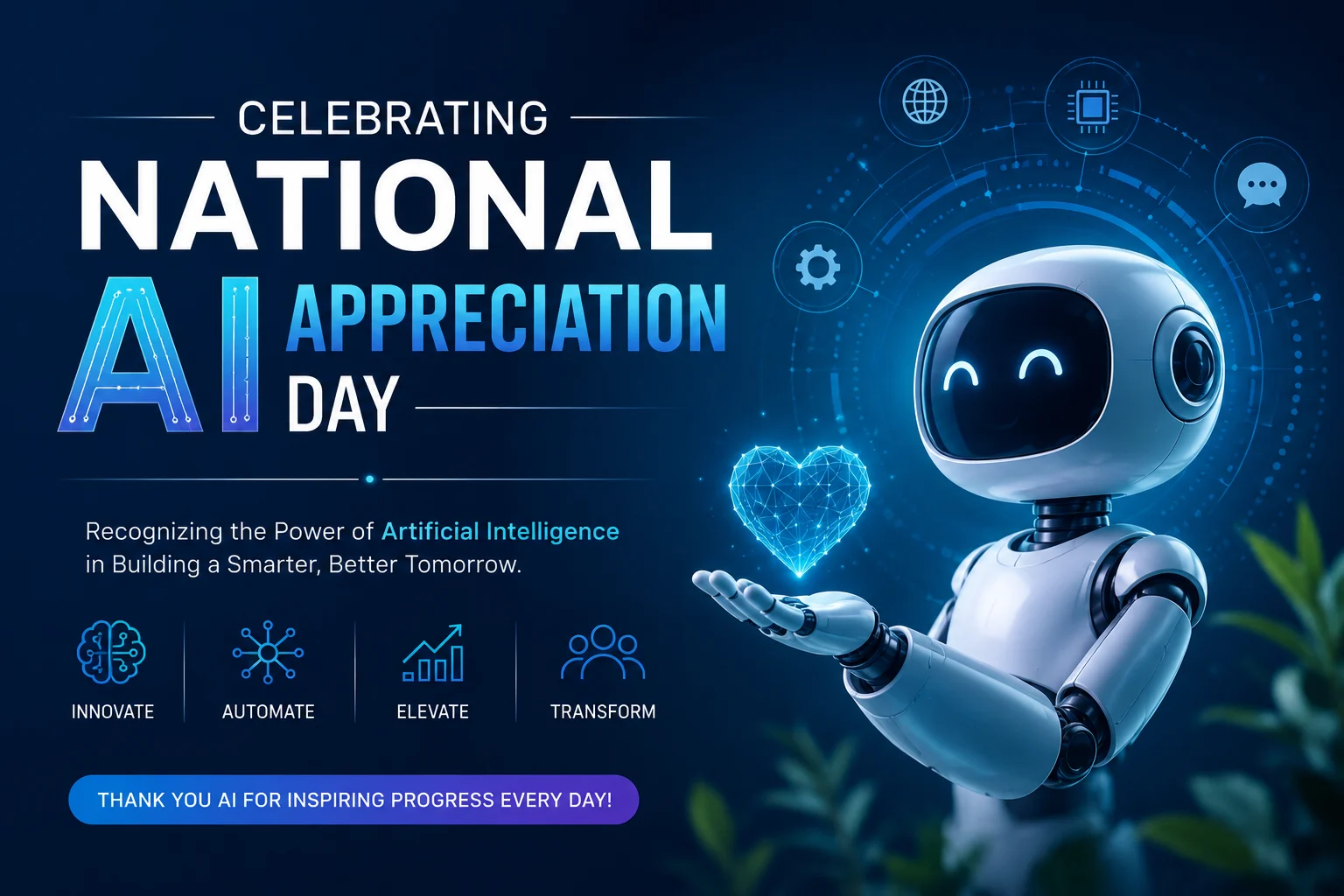
As we celebrate National AI Appreciation Day, we are not merely recognising a remarkable technological breakthrough—we are acknowledging one of the most defining moments in human history.
Artificial Intelligence is no longer an emerging technology waiting for widespread adoption. It has become a strategic force reshaping economies, transforming industries, redefining careers, and accelerating innovation at a pace never seen before. The question is no longer whether AI will influence our future; it is already influencing our present.
What truly makes this moment extraordinary is that Artificial Intelligence is not replacing human potential—it is expanding it.
For centuries, humanity has advanced through innovation. The printing press democratised knowledge. Electricity transformed industries. The internet connected the world. Today, Artificial Intelligence stands as the next great leap forward—not because it replaces human intelligence, but because it amplifies our ability to solve problems, make better decisions, discover new possibilities, and create meaningful impact.
Across the globe, AI is becoming the invisible engine powering progress. It is enabling doctors to detect diseases earlier, helping researchers accelerate scientific discoveries, empowering businesses to make data-driven decisions, supporting farmers through precision agriculture, improving manufacturing with intelligent automation, and allowing creative professionals to reimagine storytelling, design, and digital experiences.
This is no longer a technology revolution.
It is a transformation of every industry, every profession, and every institution.
For businesses, AI has evolved from being a competitive advantage to becoming a strategic necessity. Organisations that successfully integrate Artificial Intelligence into their decision-making, operations, customer experiences, and innovation strategies will define the next era of growth. Those that fail to adapt risk being left behind in an increasingly intelligent economy.
Yet, technology alone will never determine success.
The true differentiator will always be people.
One of the greatest misconceptions surrounding Artificial Intelligence is that it will replace human talent. History suggests otherwise. Every major technological revolution has created new opportunities, new industries, and new ways of working. AI is no exception. While routine tasks will increasingly be automated, uniquely human capabilities—creativity, empathy, ethical judgement, critical thinking, collaboration, and visionary leadership—will become more valuable than ever before.
The future workforce will not compete against AI.
It will collaborate with AI.
This reality places an important responsibility on educational institutions.
Universities are no longer preparing students for a single profession; they are preparing them for a lifetime of continuous learning in a rapidly evolving world. Future-ready education must go beyond classrooms and textbooks. It must integrate Artificial Intelligence, foster innovation, encourage interdisciplinary thinking, strengthen industry partnerships, and cultivate entrepreneurial mindsets that empower students to solve challenges we have yet to imagine.
AI literacy should no longer be viewed as a specialised skill reserved for technologists. It is becoming a fundamental competency across professions—from engineering and management to healthcare, law, finance, design, and public policy. The leaders of tomorrow will not simply understand Artificial Intelligence; they will know how to apply it responsibly to create lasting value for society.
However, as we accelerate innovation, we must also strengthen our commitment to responsible development. Artificial Intelligence brings extraordinary opportunities, but it also raises important questions around ethics, transparency, privacy, cybersecurity, fairness, and accountability. The future of AI will not be defined solely by technological breakthroughs—it will be defined by the principles that guide its development and the responsibility with which we choose to use it.
As we look towards the next decade, the possibilities are extraordinary. Imagine a world where healthcare becomes predictive rather than reactive, education adapts to every learner, scientific discoveries happen faster than ever before, businesses make smarter decisions in real time, and sustainable technologies help address some of humanity’s greatest challenges. That future is no longer a distant vision—it is already taking shape.
National AI Appreciation Day is therefore much more than a celebration of technology.
It is a celebration of human ingenuity.
It is a celebration of curiosity, innovation, collaboration, and the limitless possibilities that emerge when intelligence and technology work together with purpose.
More importantly, it is a reminder that the future will not be built by Artificial Intelligence alone.
It will be built by people who choose to learn continuously, innovate fearlessly, lead responsibly, and harness AI to create a more inclusive, sustainable, and prosperous world.
The greatest opportunity of the AI era does not lie in the technology itself.
It lies in how we choose to use it.
What are your thoughts?
As Artificial Intelligence continues to reshape industries, education, and society, what do you believe will be its greatest contribution over the next decade?
Will it redefine healthcare, revolutionise education, transform businesses, accelerate scientific discovery, or unlock opportunities we have yet to imagine?
I’d love to hear your perspective. Let’s celebrate National AI Appreciation Day by starting a meaningful conversation about the future we are building together.



 NU is all about fresh perspectives. So is our website.